

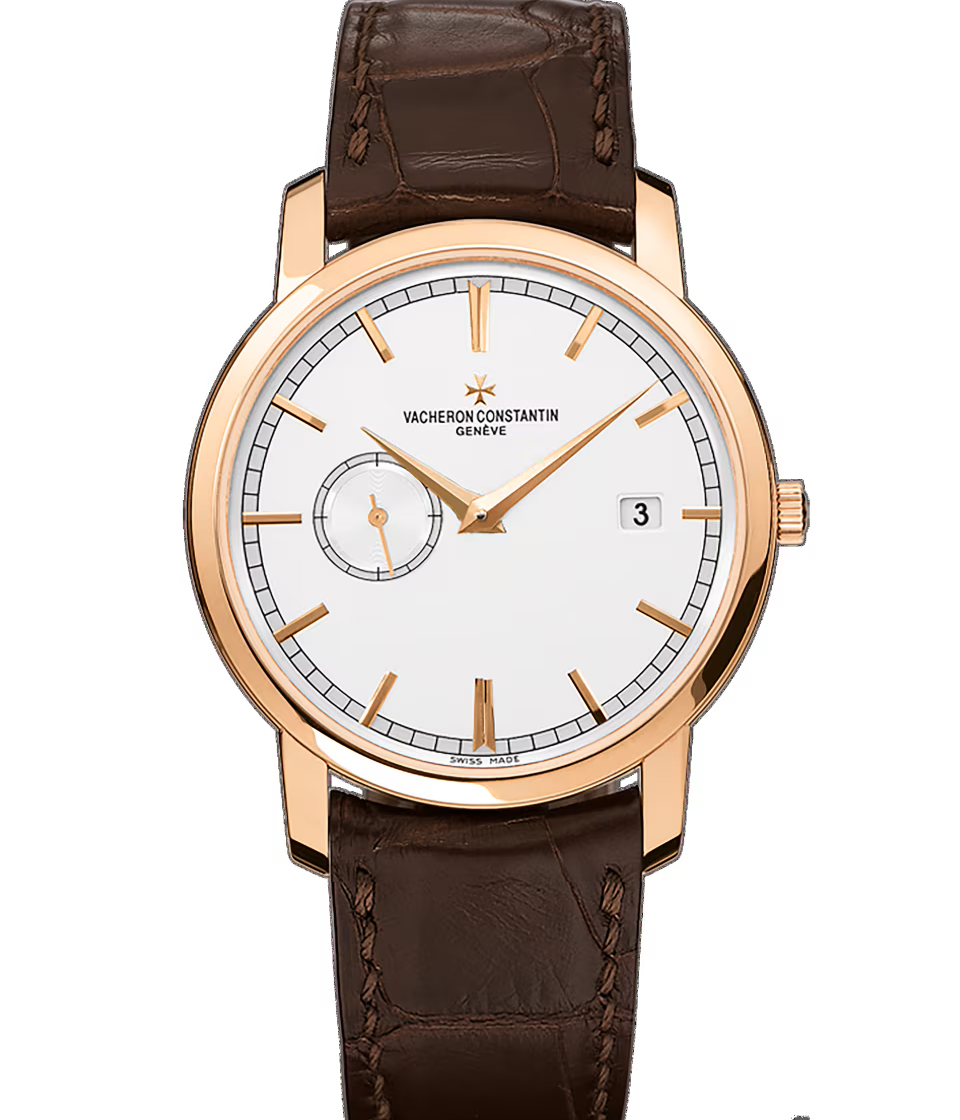
Traditionnelle
History of the line
The Traditionnelle line was presented in 2007 with the stated aim of bringing together, in a single family of cases, the most classic and "traditional" language of Geneva haute horlogerie: an aesthetic that draws directly on the codes of late-19th and early-20th-century pocket watches, with a railway-style minute track, applied baton indices and a small seconds counter taken straight from pocket watches.
The most recognisable detail of the Traditionnelle case is its pair of downward-curving lugs, designed to hug the wrist in visual continuity with the case side; on the dial, just above the manufacture's signature, is the applied gold Maltese cross, underlining the model's place in the Vacheron Constantin catalogue. In 2009 the line was expanded with the introduction of the in-house manual calibre 4400, which became the basis for numerous later versions.
Unlike the Patrimony, designed for maximum thinness and absolute minimalism, the architecture of the Traditionnelle case was conceived from the outset to house a much wider range of complications without losing its identity: from three-hand versions to tourbillons, perpetual calendars, chronographs and moon phases, the line is today one of the manufacture's favourite grounds for expressing its most complex haute horlogerie in an openly classic guise.
Line features
Key milestones of the line
The "railway" minute track, with its fine marks recalling rails seen from above, is a detail inherited directly from early-20th-century pocket watches: the Traditionnelle line has made it one of its most immediate hallmarks, to the point that it appears on almost every version in the collection, from the simplest to the most complicated.