

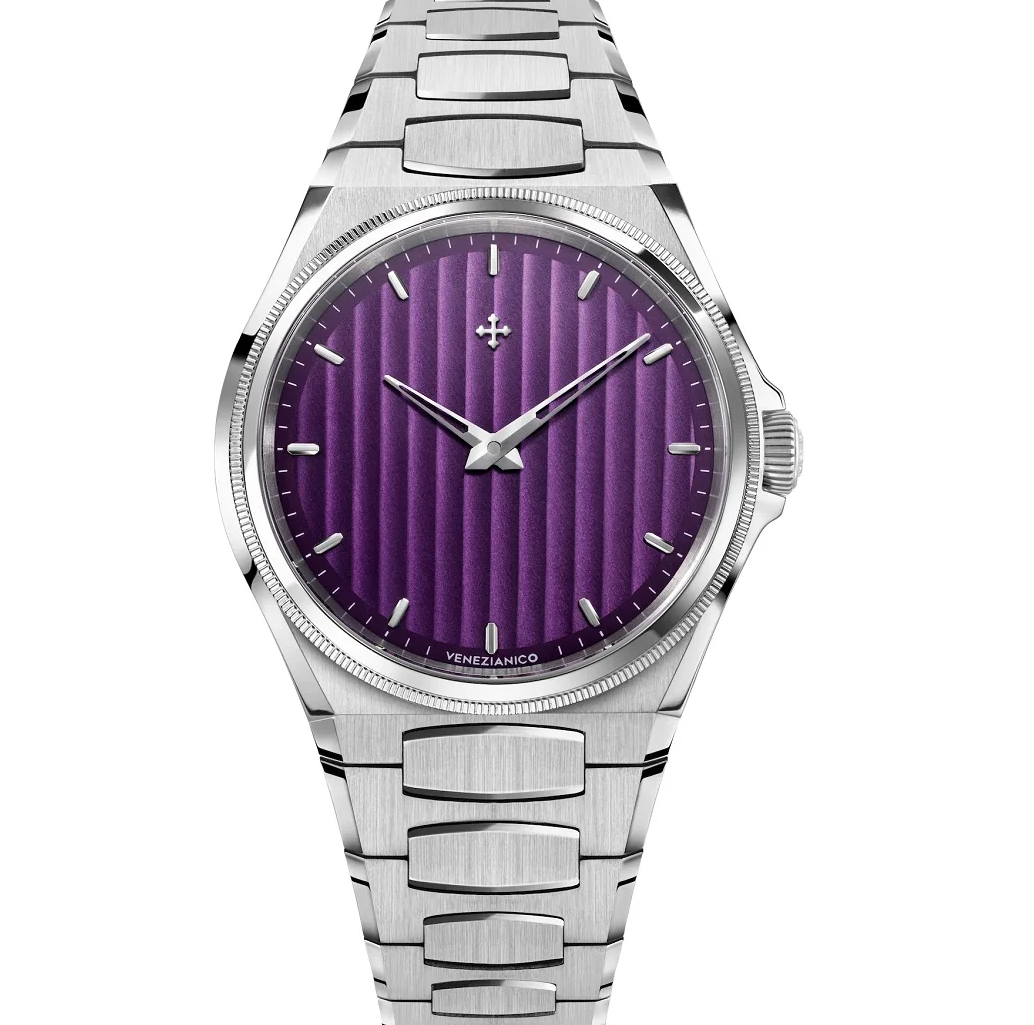
Arsenale
History of the collection
Arsenale is the collection with which, between 2022 and 2024, Venezianico entered the segment of sports watches with integrated bracelets, one of the most crowded and debated territories in contemporary watchmaking. The name pays tribute to the Arsenale of Venice, the Serenissima's historic shipyard which for centuries was the heart of the city's maritime power: a complex that, with its proto-industrial organisation based on serial production and division of labour, effectively anticipated principles that would only become central with the Industrial Revolution, centuries later. Within its walls cannons, anchors and everything needed to build and equip the ships of the Venetian fleet were forged.
It is precisely this ability to innovate starting from an ancient manufacturing tradition that inspired Venezianico in designing the Arsenale: a slim case, just 8.95 millimetres thick, combined with an integrated bracelet with alternating satin and polished finishes, for a result the brand describes as a meeting point between historical heritage and contemporary aesthetics. Unlike other Venezianico collections, the Arsenale was launched with hand-wound mechanical movements, a choice that favours the essential slimness of the case over the convenience of automatic winding.
Over time the range has grown with new variants in 37 and 40 millimetre diameters, with materials ranging from steel to bronze and platinum, and versions with meteorite or stone dials such as aventurine, as well as a calendar model. Although it is one of the youngest collections in the catalogue, the Arsenale has quickly established itself as one of Venezianico's most popular offerings among affordable integrated-bracelet sports watches.
Technical specifications
Main versions
On 20 July 1574, before the astonished eyes of King Henry III of France on a visit to Venice, the Arsenale's workers assembled an entire galley — complete with rigging, sails, oars and weapons — in a single day, a vivid demonstration of the shipyard's production organisation. No wonder the Arsenale had already struck Dante Alighieri's imagination two and a half centuries earlier: in Canto XXI of the Inferno the poet compares the boiling pitch in which the damned grafters are immersed to the pitch that bubbled in the "Arzanà de' Viniziani" for caulking ships' hulls.