

Antiqua
Model history
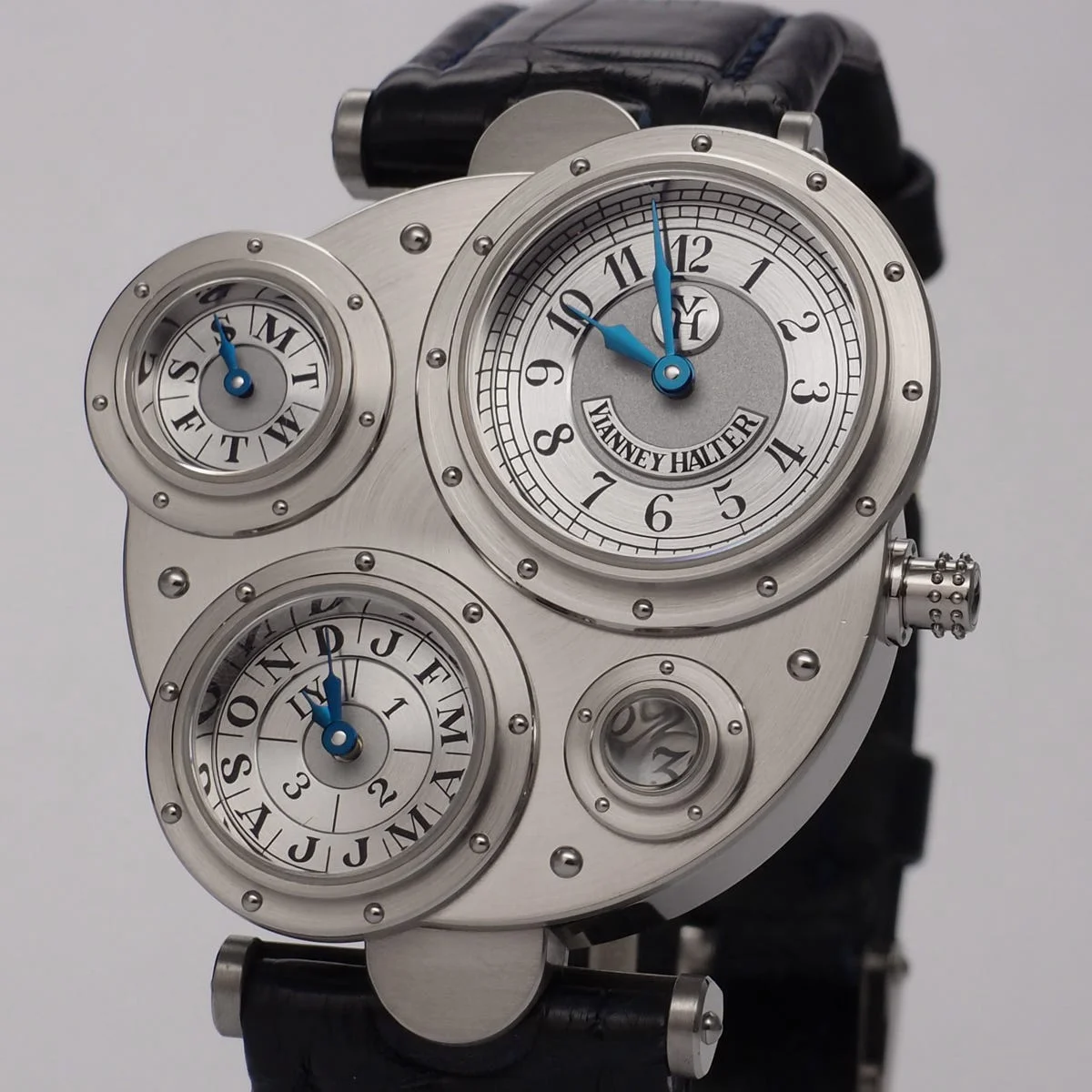
Presented at the Basel Fair in 1998, the Antiqua was Vianney Halter's very first watch under his own name, after years spent restoring antique timepieces and developing complications for other maisons. The dial is arranged in four tiered portholes supported by cones, showing respectively hours and minutes, months with leap-year indication, day of the week and date: a way of reading a perpetual calendar entirely new to the watchmaking tradition of the time. The case, studded with about a hundred small rivets, imagines a future seen through the 19th-century eyes of Jules Verne, so much so that it is often described as a piece Captain Nemo could have designed. The Antiqua's immediate success with collectors and with other independent watchmakers, including Philippe Dufour, is what led Halter, two years later, to join the AHCI.
Technical specifications
Main versions
The Antiqua's automatic winding rotor is made partly of transparent sapphire: a device patented by Halter, the "mystery rotor", which allows the movement to be admired at work without the oscillating weight hiding it from view, as happens in most automatic watches.