

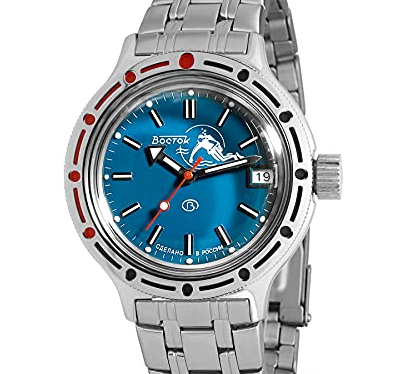
History of the line
The Amfibia (Amphibia) was born in 1967 at the Chistopol watch factory, in Tatarstan, at the request of the Soviet Navy, which was looking for a truly rugged dive watch without having to copy existing Western water-resistance patents. The design was led by engineer Mikhail Novikov and designer Vera Belova, the same team who a few years later would also create the 300-metre NVCh-30 diver: their solution was a two-piece crown system which, instead of simply resisting water pressure, used it to further strengthen the case's seal the deeper one dived.
The result was a watch stated to be water-resistant to 200 metres, with a monocoque steel case, acrylic crystal and a large crown designed to be operated even with diving gloves. The first pieces were hand-wound, with calibre 2209; in the following decades the range grew to include automatic versions based on calibres 2416B and 2415, while keeping the basic architecture of the case and sealing system intact.
The Amfibia soon moved beyond purely military use to become the brand's most recognisable civilian watch, helped by its affordable price and stated toughness: in 1975 one was worn by cosmonaut Georgy Grechko during the Soyuz 17 mission to the Salyut 4 station, testament to the trust placed in the calibre's reliability even out of the water. The name and basic layout have remained in production to this day, in a very wide range of case and dial variants that the brand continues to sell as "Amphibia" or "Amphibian Classic": Western documentation on the exact numbering of each individual version, especially for recent decades, nonetheless remains fragmented.
Line features
Key milestones
In 1975 a Vostok Amfibia travelled into space on the wrist of cosmonaut Georgy Grechko, during the Soyuz 17 mission to the Salyut 4 orbital station, where he stayed for 29 days: a decidedly unusual test for a watch designed to withstand water pressure rather than weightlessness.