

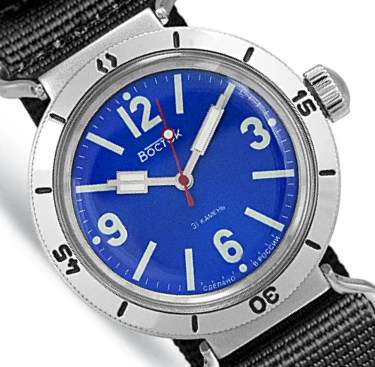
NVCh-30
History of the line
After the success of the Amfibia, presented in 1967 with a stated water resistance of 200 metres, some Soviet Navy officers asked the Chistopol factory for an even tougher watch, able to accompany combat divers and the "combat swimmers" of naval special units (forerunners of what we would now call Spetsnaz units) on deeper dives too. Thus, with production officially starting in 1971, the NVCh-30 was born (НВЧ-30, short for "Наручные Водолазные Часы 30", diving wristwatch rated to 30 atmospheres), developed by the same team as the Amfibia, engineer Mikhail Novikov and designer Vera Belova.
Unlike divers with heavy equipment and telephone communications, the NVCh-30 was intended for those operating without such support: the monocoque case was therefore reinforced with a 3.9 mm crystal, considerably sturdier than the 2.5 mm of the standard Amfibia, to withstand a stated pressure down to 300 metres. During its production history the watch went through three distinct generations: the first (1971-1979) with removable lugs and a "Type 610" case; the second (1979-1988) with a monolithic "Type 119/630" case and, from 1985, a steel crown; the third (1988-1990), with a "Type 320" case and the automatic 2409A movement, a period on which the available documentation remains scarce and unclear.
As equipment linked to specialised military units, the NVCh-30 was state property rather than a civilian watch on open sale, although some pieces were awarded as personal recognition to servicemen for exceptional service: one of these bears the engraved dedication "From the commander of the USSR Black Sea Fleet, to sailor Kurbanov A.C. 1986", linked to the rescue operations following the sinking of the cruiser Admiral Nakhimov. The brand later revived this heritage in modern times, selling a line under the name "NVCH 300" that explicitly draws on the original 1971 project.
Line features
Key milestones
One known piece bears the engraved dedication "From the commander of the USSR Black Sea Fleet, to sailor Kurbanov A.C. 1986", linked to the rescue operations following the sinking of the cruiser Admiral Nakhimov: a reminder of how these watches, although state property, were sometimes given to servicemen as personal recognition for exceptional service.