

Model history
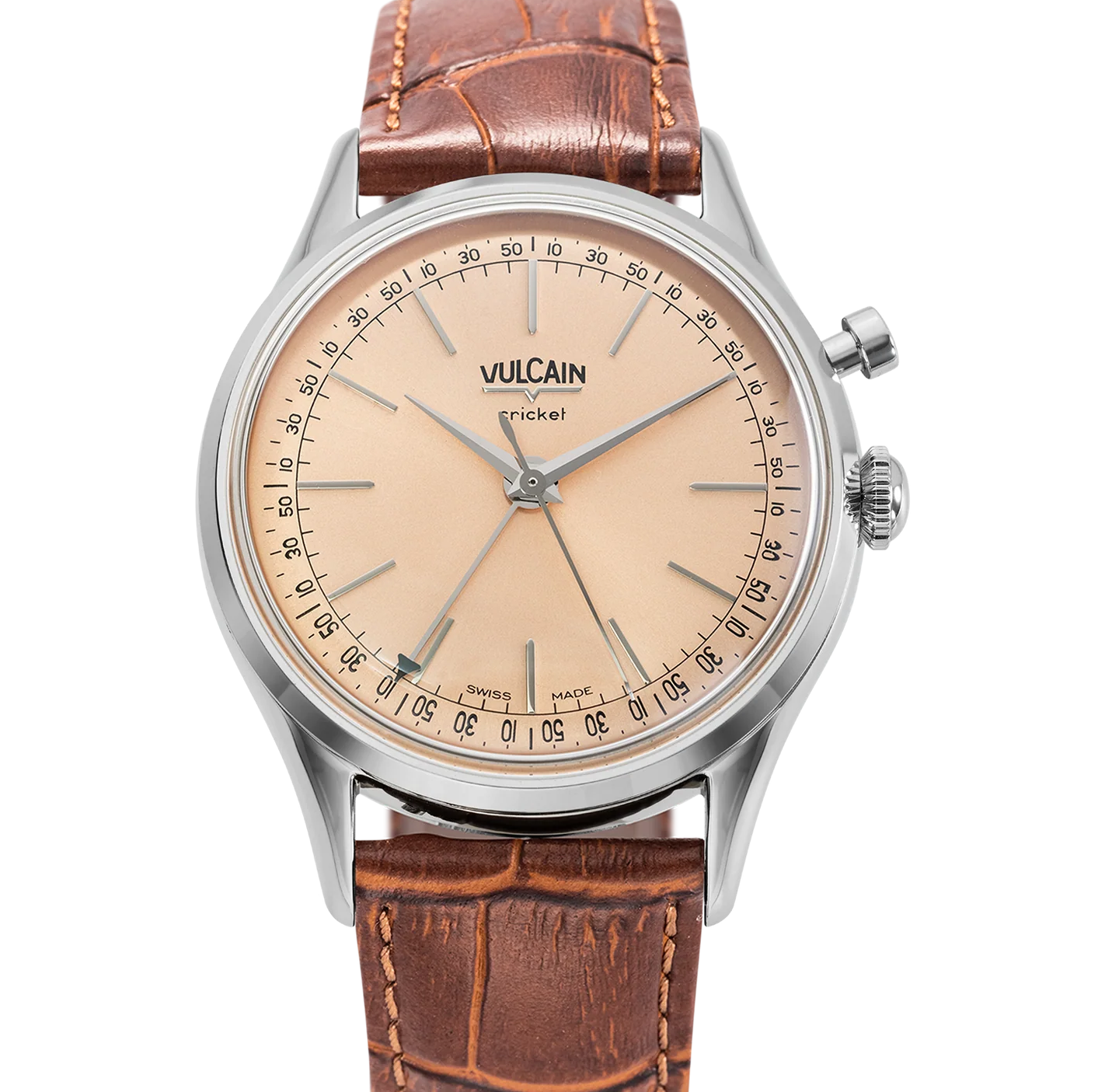
Presented in 1947, the Cricket was created to solve a problem that had until then thwarted every attempt at a wrist alarm: existing mechanisms drained too much energy from the main barrel and, with cases of around 34 mm, the sound produced was too weak to be truly useful. Vulcain's answer was a second barrel dedicated exclusively to the alarm and a double caseback, perforated and shaped to act as a resonance chamber: the internal hammer strikes a steel pin, producing a distinctive "chirp" — the same sound, according to the brand's tradition, that inspired the name, after observing a small cricket's ability to make itself heard from far away.
The resulting calibre 120 quickly won over the watchmaking community: in 1948 the Cricket won the chronometry competition of the Neuchâtel Observatory, an accolade that cemented the brand's technical reputation. But it was its practical usefulness that made it famous well beyond watch enthusiasts: in 1953 the White House News Photographers' Association gave President Harry Truman a 14-carat gold Cricket engraved "One More Please", starting a long tradition of presidential gifts. Dwight Eisenhower and Lyndon Johnson received and wore the watch in the following years — Johnson in particular became a keen advocate, going as far as having about 200 bought to hand out as official gifts — and from this series of adoptions the Cricket earned the nickname "The President's Watch".
After the brand's relaunch in 2002 in Le Locle, Vulcain resumed in-house production of the Cricket calibre and continues to offer the mechanical alarm as its signature complication, while the tradition of presidential gifts has continued in recent times too: among the best-known recipients is Barack Obama, who received a special-edition Cricket in 2009, confirming a link between the model and American politics that has lasted more than seven decades.
Technical specifications
Main versions
According to the brand's tradition, the name "Cricket" comes from the observation that a small cricket can make a sound audible from far away despite its tiny body: an image Vulcain applies to its own watch, able to make itself heard despite the very limited space available to the mechanism inside the case.