

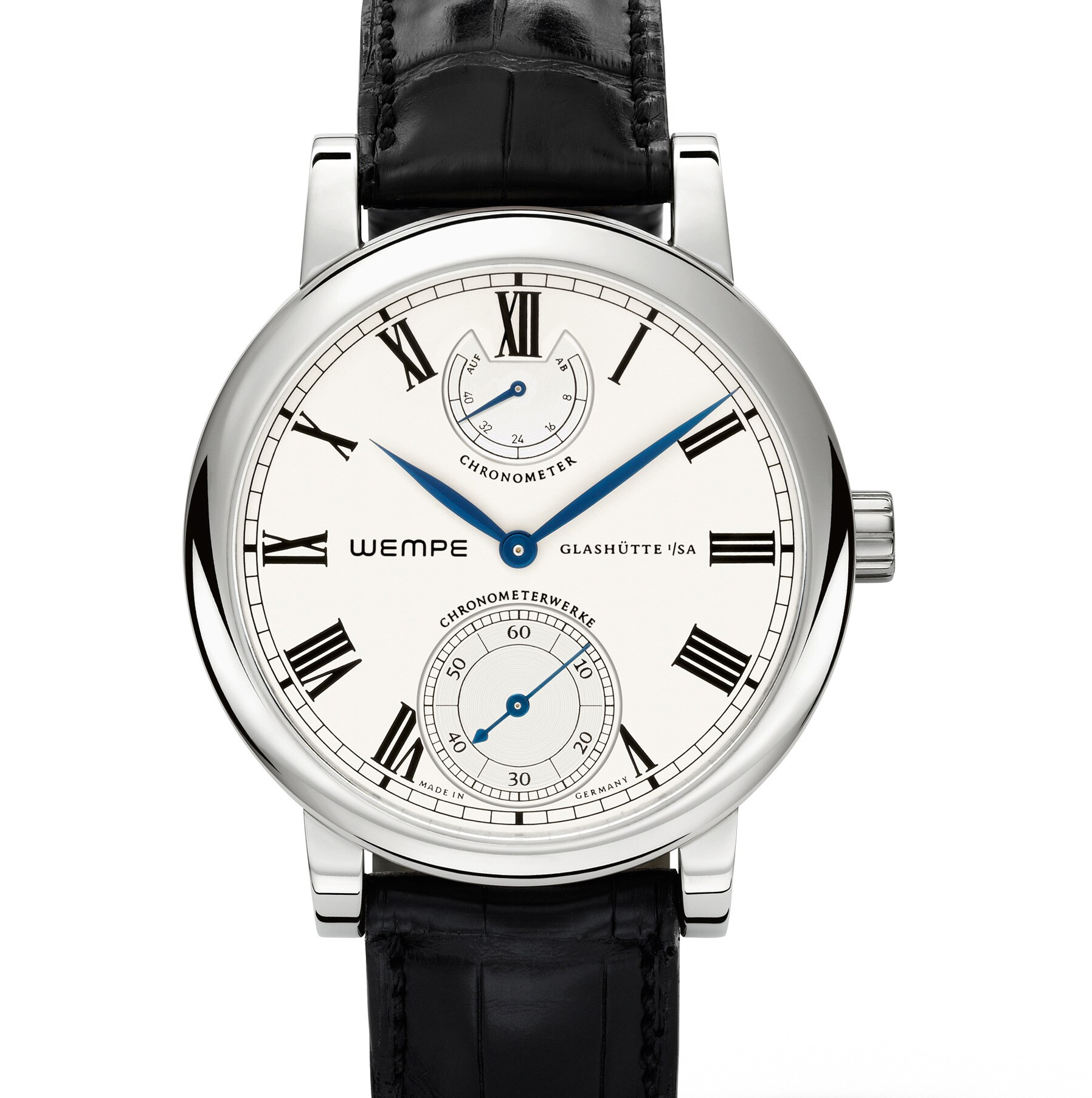
Chronometerwerke
History of the line
Presented in 2006 together with the Zeitmeister, the Chronometerwerke was born as the flagship line of the newly founded Wempe Glashütte i/SA manufacture, designed for a higher positioning than its sister line: it uses its own manufacture calibres, starting with the CW1 "Formwerk", developed in collaboration with Nomos, followed over the years by the CW2 with continuously rotating tourbillon. The name is no accident: it refers directly to Chronometer-Werke Hamburg, the historic marine chronometer manufacture founded in 1905 and acquired in 1938 by Herbert Wempe, which during the war produced chronometers for the navy and on-board instruments for aviation.
The first Chronometerwerke models adopted a tonneau-shaped case, in keeping with the line's refined and distinctive character, but met with a cooler market reception than hoped. In 2013 Wempe therefore redesigned the collection, adopting 43 mm round cases openly inspired by the classic on-board chronometers the company had produced for decades: the new dial introduced a large small seconds at 6 o'clock and a circular power reserve indicator at 12 o'clock, combined with the new CW3 manufacture calibre, developed with the French manufacture MHVJ (Manufacture Horlogère du Vallée de Joux) and featuring skeletonised components made with StruTec laser technology and a Carl Haas hairspring.
In 2016 the Glashütte manufacture took a further step with the CW4 calibre, the first automatic movement entirely developed and produced in-house, offering at least 92 hours of power reserve. Through these developments in calibre and design, the Chronometerwerke remains the line in which Wempe most clearly displays its manufacturing skills, while recalling, in its name and finishes, the legacy of the old Chronometer-Werke Hamburg.
Technical specifications
Main versions
The name "Chronometerwerke" is not a marketing invention: it comes directly from Chronometer-Werke Hamburg, the marine chronometer manufacture founded in 1905 and taken over by Herbert Wempe in 1938, which still produces nautical instruments in Hamburg today — a direct thread between the group's commercial history and its most prestigious watch line.