

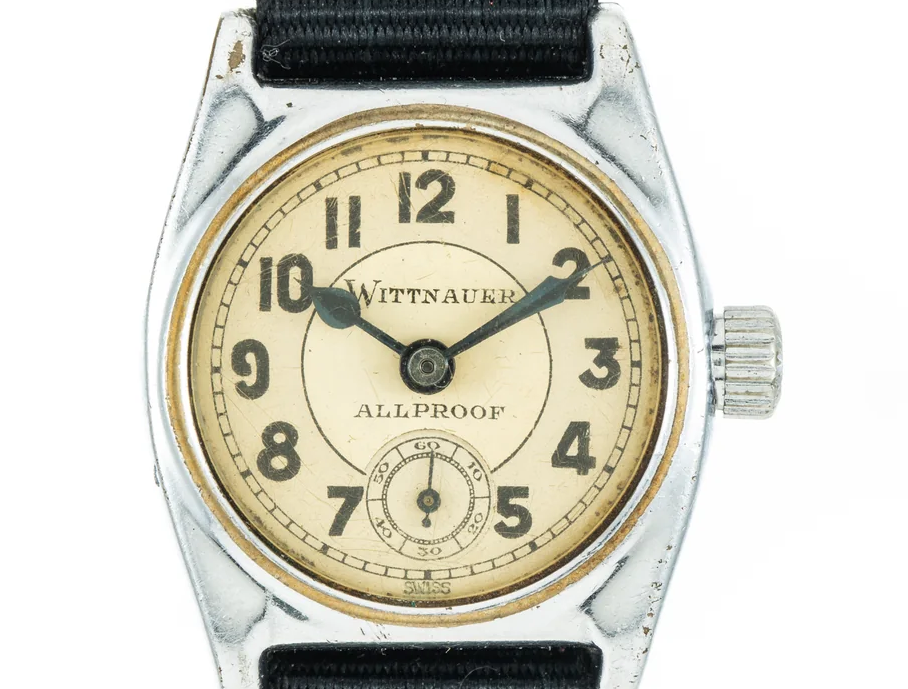
AllProof
Model history
Launched in 1918, the AllProof was the first line to give Wittnauer a true technical identity, at a time when the brand operated mainly as an importer and distributor of Swiss watches on the American market. The name itself — "proof against everything" — sums up its declared ambition: a watch that was waterproof, shockproof and antimagnetic all at once, three features rarely found together in a single model in those years.
The advertising campaign of the time relied on extreme demonstrations: according to several industry sources, one piece was dropped from an aeroplane at about 3,400 feet and kept underwater for 30 hours, still working correctly at the end of the tests. This kind of test, typical of watch marketing in the early decades of the 20th century, helped build around the AllProof a reputation for reliability that the brand would cultivate throughout the following century.
The line soon became linked to pioneering aviation: pilot Jimmie Mattern wore an AllProof during his 1933 attempt to fly around the world, and on returning from a crash that left him missing for days in Siberia he publicly praised its toughness. Several amateur sources also report that Neil Armstrong wore the same model during the 1966 Gemini 8 mission: this is a recurring claim on enthusiast websites, but it is not confirmed by official NASA or Wittnauer documentation and should therefore be treated with caution.
Technical specifications
Main versions
The Wittnauer brand is sometimes linked to the US space programme through the AllProof too, because of the connection with Neil Armstrong: a recurring association in the brand's amateur narrative but one which — unlike the better-documented case of the 242T chronograph submitted to NASA testing — has so far found no confirmation in verifiable primary sources.