

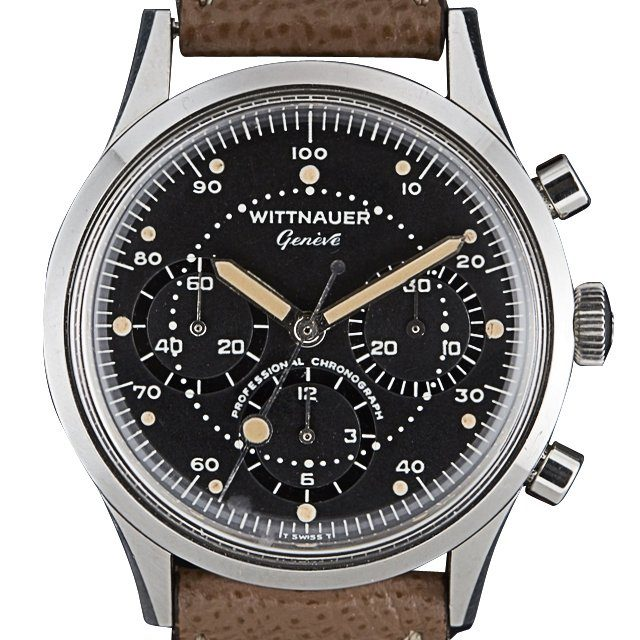
Professional Chronograph
Model history
In the second half of the 1960s, when Wittnauer was still closely linked with Longines, the brand presented a family of rugged chronographs aimed at professionals: pilots, servicemen and explorers. The line's most celebrated reference is the 242T, a chronograph with a 38 mm steel case, hand-wound Valjoux 72 movement and a matt black dial with three counters (30 minutes, 12 hours, running seconds) and an outer decimal scale designed for air navigation calculations.
The 242T is remembered by enthusiasts and several specialist dealers as one of the possible candidates submitted, along with models from Rolex, Breitling and Omega, to the qualification tests NASA carried out to choose the chronograph to be issued to Gemini and Apollo astronauts. No source, neither NASA nor Wittnauer itself, has ever officially confirmed this participation: it is therefore a recurring but not reliably documented hypothesis, fuelled also by its technical similarity to the chronographs actually tested in those years. The outcome of the selection, in any case, is well known: it was the Omega Speedmaster that was qualified for use in space.
Despite — or perhaps precisely because of — this never-confirmed association, the 242T and the related references in the line (including the 235T and the rarer 245T with GMT function introduced in the 1970s) are today among the vintage Wittnauer chronographs most sought after by collectors, prized for their rugged construction and for the appeal of the "untold story" linked to the space race.
Technical specifications
Main versions
The never-proven link between the 242T and the NASA tests has nonetheless had a very real effect on the collectors' market: according to several specialist dealers, the best-preserved pieces of this reference have exceeded $10,000 at auction, a value fuelled largely by the appeal of a journey into space that, in reality, this chronograph never made.