

Academy
Model history
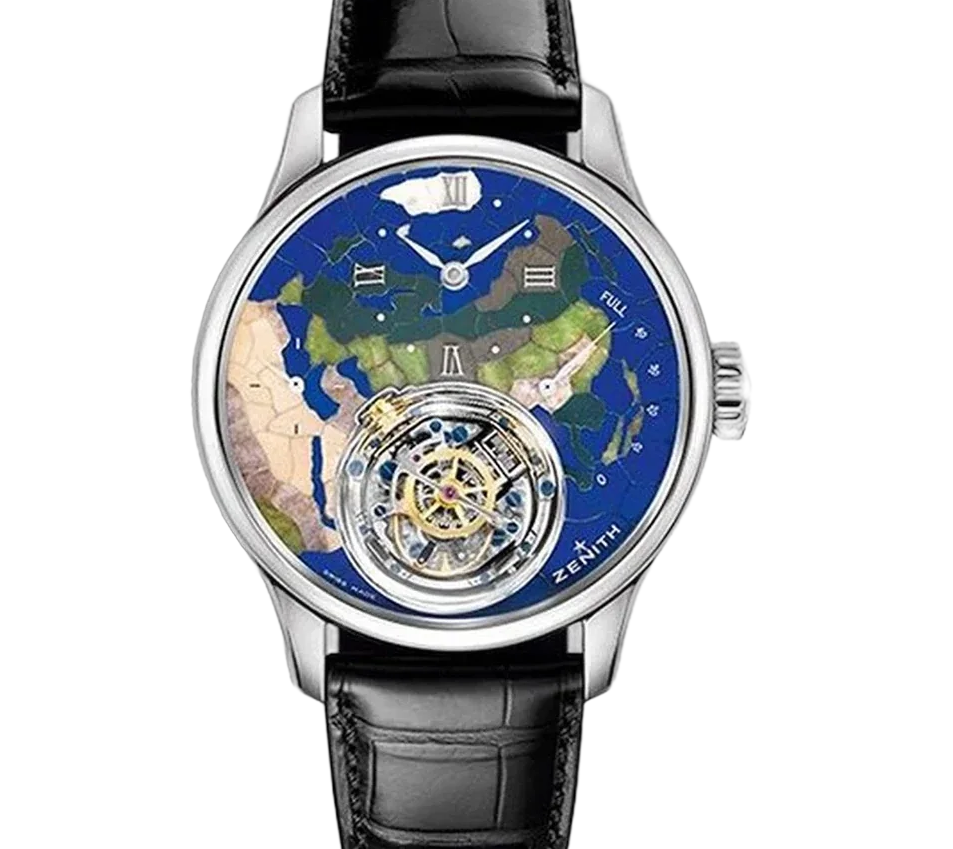
The Academy was born as a home for the most experimental complications in the Zenith catalogue, in a deliberately more modern and "semi-sporty" aesthetic register than the more classic language reserved for other Swiss haute horlogerie. The model that opened the line in its current sense in 2010 is the Christophe Colomb, named after the Genoese navigator and built around a patented mechanism — the "Gravity Control" gyroscopic cage — able to keep the escapement horizontal relative to the horizon regardless of wrist movements, thanks to a suspension system the brand links to the gimbals used since the 16th century on ships' compasses and, later, on marine chronometers.
The very design of the Christophe Colomb makes this architecture visible: a sapphire "bubble" protrudes above and below the case to leave room for the cage to swing, while a small terrestrial globe built into the counterweight explicitly recalls the theme of exploration and transoceanic voyages. The project's technical value was recognised as early as 2011, when the Christophe Colomb Équation du Temps variant won the Prix de la Montre Compliquée at the Grand Prix d'Horlogerie de Genève, one of the industry's most prestigious awards.
In the following years the Academy line gained ever more ambitious variants: in 2013 the Hurricane version combined the gyroscopic cage with a chain-and-fusée mechanism — a historic system for equalising driving force, already used in marine chronometers to ensure more constant torque as the mainspring unwinds — and in 2016 the Academy Georges Favre-Jacot Tourbillon, dedicated to the manufacture's founder, combined for the first time at Zenith the chain-and-fusée mechanism with a tourbillon, through calibre 4805. The Academy thus remains the showcase for the brand's most elaborate technical solutions, produced in very limited series compared with the other lines.
Line features
Main versions
The gyroscopic cage principle driving the Christophe Colomb was not born for wristwatches: Zenith links it to the gimbal suspension systems used since the 16th century on ships' compasses to keep them level despite the ship's roll — the same need, applied here to keeping the escapement stable against the movements of the wrist.