

Chronomaster
Model history
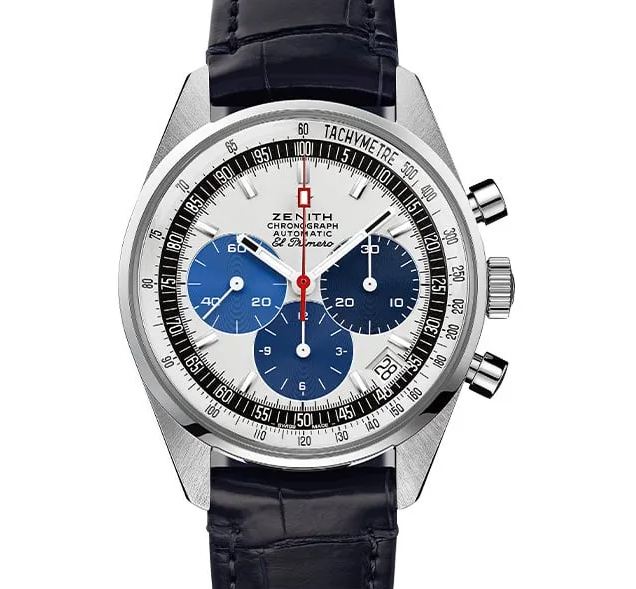
The line's founding model, reference A386, was presented on 10 January 1969 together with the El Primero calibre: a column-wheel automatic chronograph movement with integrated barrel, beating at 36,000 vibrations per hour (5 Hz) and therefore able to read tenths of a second, a precision then rare in a series movement. The A386 dial, with its three counters in silver, anthracite and blue — or in "grey-blue-anthracite" variants according to some sources — became the visual hallmark that would accompany the line for decades to come, so much so that it remains the design reference for today's models.
The name "Chronomaster" was adopted more recently as the official label for the El Primero chronograph family, distinguishing it from the other lines in the Zenith catalogue; over time several generations of calibres derived from the original design have passed under that name, up to the current El Primero 3600, which keeps the high-frequency architecture but raises the power reserve to around 60 hours, a far cry from the roughly 50 hours of the 1969 calibre.
The link between the line and the original calibre has been celebrated several times with relaunches faithful to the original design — from the Chronomaster Original to the Revival A386 — reproducing the proportions and colours of the 1969 dial, often with a transparent caseback that reveals the movement's column wheel. As noted on the brand page, the very claim behind the name "El Primero" remains tied to a historic dispute over who made the first automatic chronograph, not conclusively resolved between Zenith, the Chronomatic consortium and Seiko.
Line features
Main versions
The El Primero calibre powering the Chronomaster is the same one, in derived form, that Rolex used — modified and renamed Cal. 4030 — in its Daytona chronographs from 1988 to 2000: for more than a decade, then, the technical heart of the Zenith line also beat inside one of the competition's most famous watches.