

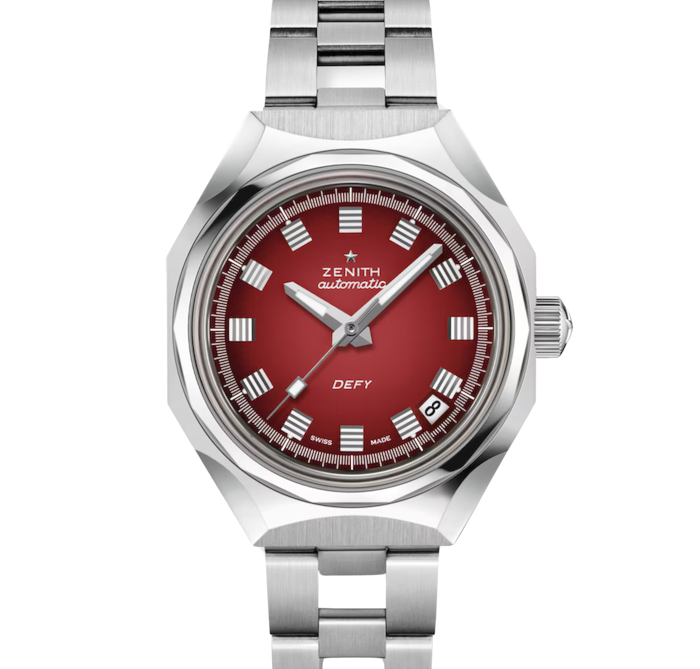
Defy
Model history
The Defy was born in 1969 with reference A3642: an angular, octagonal case closed by a fourteen-sided bezel, designed above all to convey toughness and shock resistance — hence the name. The design, unusually geometric and industrial for the time, in some ways anticipated the language that Gérald Genta would popularise a few years later on other steel sports watches, but on its release the model was not a great commercial success, long remaining a minor chapter compared with Zenith's chronographs of the same period.
In the 1970s the line continued with a second generation that simplified the case while keeping the fourteen-sided bezel, and introduced a chronograph version based on the in-house calibre 3019 PHC — an El Primero variant with date — that tied the Defy more closely to the brand's technical heritage. The name then stayed in the background for several decades, until a mid-2000s relaunch with the Defy Xtreme series, which introduced skeletonised dials openly showing the El Primero movement, in a deliberately more avant-garde guise than the rest of the catalogue.
The most recent breakthrough came in March 2017 with the Defy El Primero 21, which brought into the line a calibre able to time to a hundredth of a second thanks to a second gear train dedicated to the chronograph function, oscillating at 360,000 vibrations per hour (50 Hz) alongside the traditional 5 Hz timekeeping train. Since then the Defy has lived on in several families — from the more compact Defy Classic to the Defy Skyline, presented for the manufacture's 160th anniversary in 2025 — that share the sporty character and the link with high frequency, though they have moved far from the octagonal case of the original 1969 model.
Line features
Main versions
In 2022 Zenith reissued the first 1969 Defy A3642 almost faithfully as part of the Defy Revival series, bringing back into production the octagonal case and fourteen-sided bezel that had characterised — and partly held back commercially — the original model.