

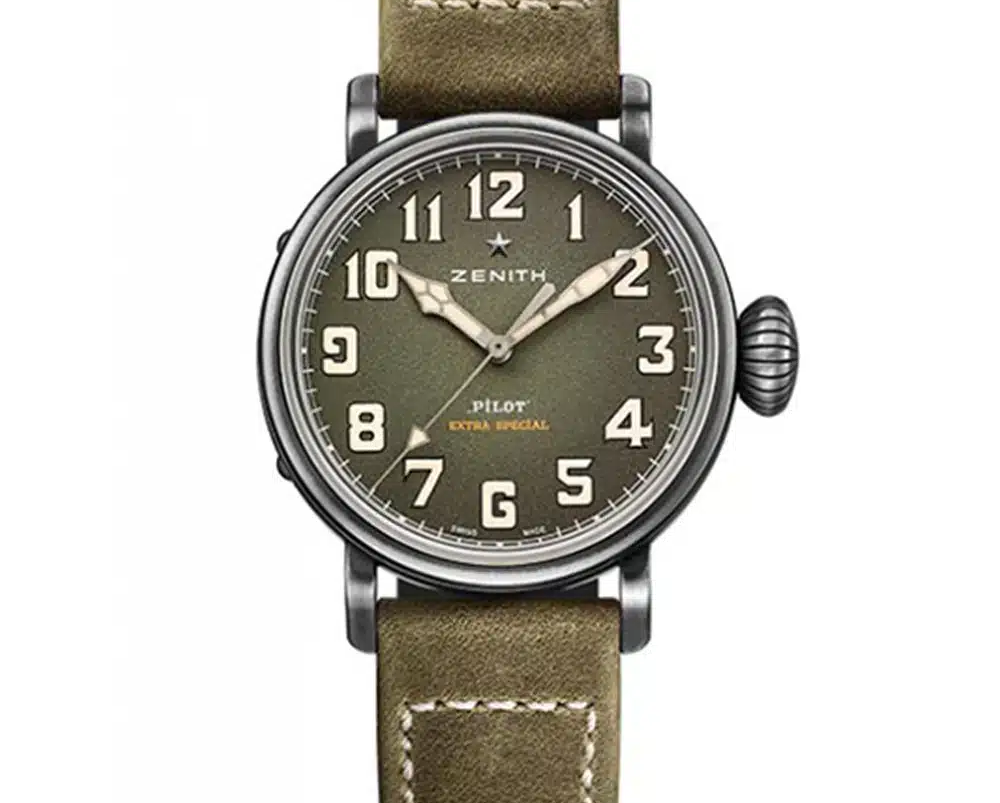
Pilot
Model history
The brand traces Zenith's link with aviation back to 1909, when French aviator Louis Blériot made the first flight across the English Channel wearing, by his account, a Zenith watch: an episode which, whether true or reworked over time by company marketing, remains the narrative starting point for the entire Pilot line today. The more concrete and documented chapter came later, however, when from 1939 the French Air Force commissioned from Zenith the Montre d'Aéronef Type 20: not a wristwatch, but a dashboard instrument for aircraft instrument panels, with large luminous numerals designed for quick reading in poor visibility and a large knurled crown that could be operated even with flying gloves.
For decades the name "Type 20" therefore remained associated with an on-board instrument rather than a wristwatch proper, a technical legacy rather than a continuous commercial line. It was only in 2012 that Zenith turned this legacy into a true wristwatch collection: the Pilot Montre d'Aéronef Type 20 was presented at Baselworld as a limited edition of 250 pieces, faithfully reproducing the features of the original instrument — the oversized numerals, the fluted crown, the spartan graphic layout — translated into a titanium wristwatch case with a hand-wound movement.
The success of that relaunch paved the way for a wider family: 2013 brought a version with annual calendar and chronograph, 2014 a commemorative GMT edition dedicated to 1903 (a year often associated, more by convention than by precise documentation, with the dawn of powered flight), followed by further variants in bronze and in skeletonised versions. Of all the Zenith collections, the Pilot line thus remains the one most explicitly built on the story — partly amplified by brand narrative — of an aviation heritage rooted in the on-board instruments of the first half of the 20th century.
Line features
Main versions
The large, deeply grooved crown that still characterises the Pilot line is not an aesthetic quirk: it stemmed from the very practical need to operate it with flying gloves, worn in the unpressurised cockpits of aircraft in the first half of the 20th century.