

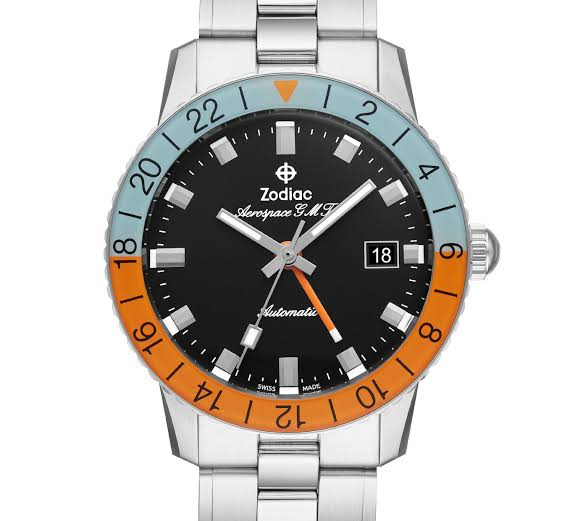
Aerospace GMT
History of the line
Launched in 1960 according to the brand's official chronology, and followed in 1962 by the Aerospace Jet variant, the Aerospace GMT was born at the height of Western enthusiasm for supersonic aviation and the first steps of space exploration — a climate the line's very name openly embraces. Zodiac conceived it as an instrument for people moving between time zones, starting with the civil and military pilots of the time.
Its most recognisable element is the two-tone orange and blue bezel, whose design recalls the attitude indicators ("artificial horizon") found in cockpits of the period: a way of bringing to the wrist a visual language borrowed directly from flight instruments. The additional 24-hour hand, combined with the rotating bezel, allows a second time zone to be read at a glance.
The original pieces, more compact than contemporary reissues, used a Bakelite bezel more fragile than today's materials — a detail that now makes vintage pieces in good condition particularly sought after by collectors. The Aerospace name has remained in the Zodiac catalogue as a byword for its approach to GMT watches, revived over the years in various configurations.
Technical specifications
Main versions
The name itself, "Aerospace", tells of the cultural climate of its time: a decade that imagined a future dominated not only by supersonic air travel but also by space exploration, and which Zodiac chose to tap into with a watch designed for those living between time zones and cockpits.