

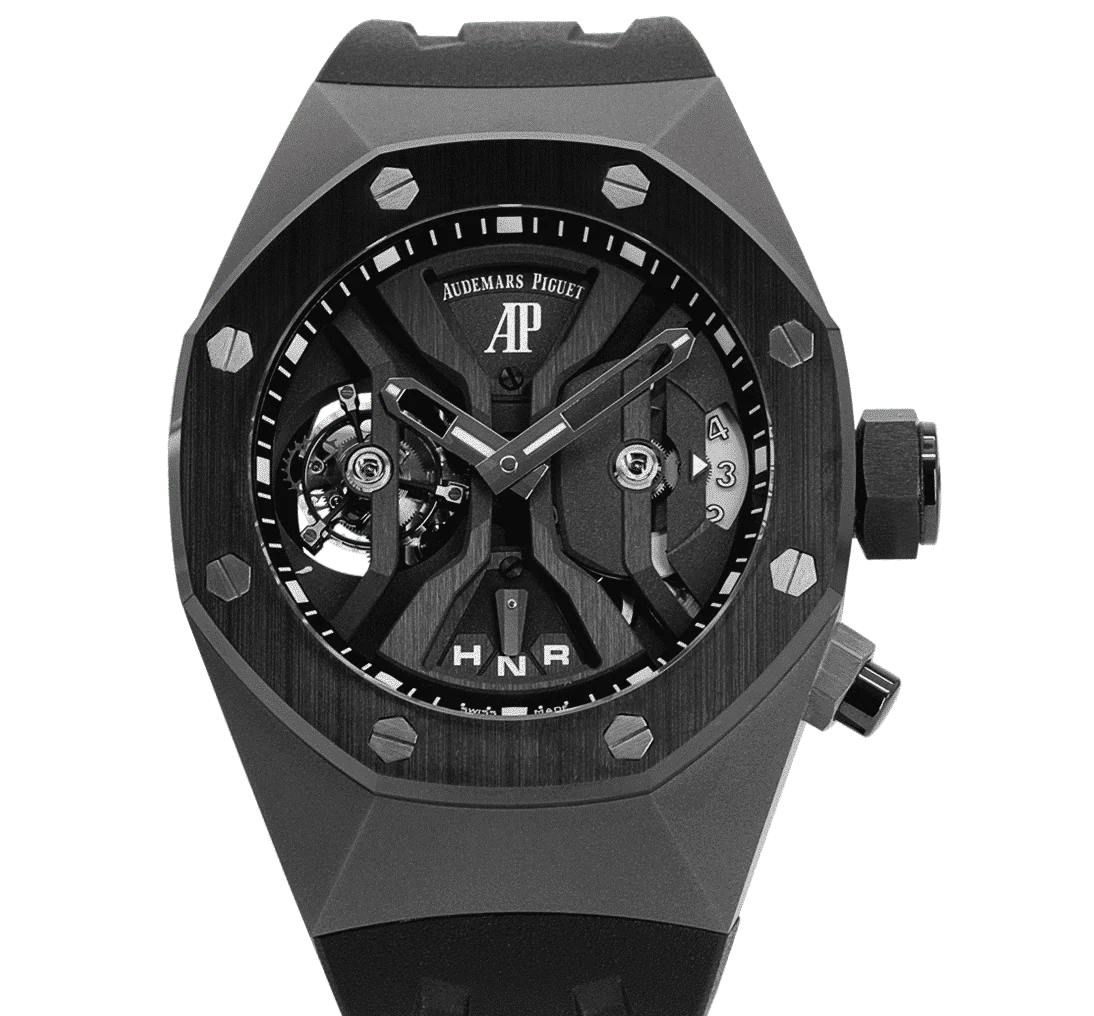
Royal Oak Concept
Model History
The Royal Oak Concept debuted in 2002, on the occasion of the original Royal Oak's 30th anniversary, with reference 25980AI.OO.D003SU.01, known among collectors also by its internal code "CW1." The stated goal was not to offer yet another aesthetic variant of Gérald Genta's octagon, but to turn that language into a testbed for technical solutions and materials the brand had never before used in a wristwatch.
The first model introduced Alacrite 602, a cobalt-based alloy (roughly 57% cobalt, 31% chromium, 5% tungsten) developed for the aerospace and medical industries, chosen for its hardness — more than double that of ordinary steel — and for an appearance similar to platinum while remaining a non-precious material. The CW1 also housed a tourbillon designed to withstand accelerations of up to 5,000 g, publicly demonstrated by the brand by dropping the watch from a considerable height, and introduced a dynamograph to measure the mainspring's residual torque in real time.
Over the following two decades the Concept line has hosted some of the most extreme complications Audemars Piguet has ever produced, including collaborations with Formula 1 driver Michael Schumacher (the "Laptimer," with a split-seconds chronograph function) and versions with GMT and a supersporty tourbillon in materials such as forged carbon and ceramic. Though it remains a niche line with very limited volumes, the Royal Oak Concept is considered by industry insiders to be the brand's primary testing ground for technical experimentation, often anticipating solutions later adopted, in more restrained form, on the higher-volume Royal Oak and Royal Oak Offshore lines.
Technical Specifications
Main Executions
To demonstrate the shock resistance of the first Royal Oak Concept's tourbillon, Audemars Piguet publicly dropped the watch from a height of several meters during its presentation: a gesture meant to communicate, in the most direct way possible, how the Concept line was conceived as an extreme testing ground for the brand's technical innovations rather than a simple styling exercise.