

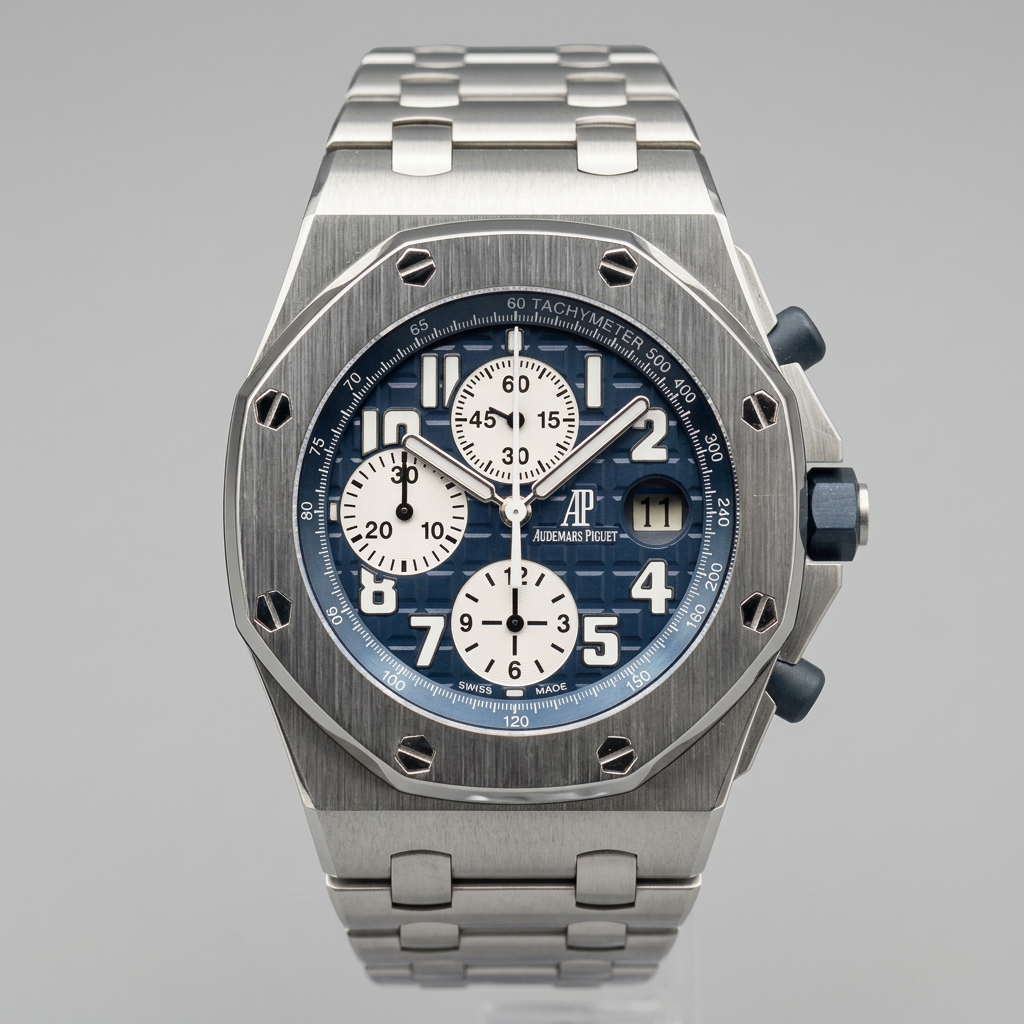
Royal Oak Offshore
Model History
Presented in 1993 with reference 25721ST, the Royal Oak Offshore was born from a brief given to young designer Emmanuel Gueit: create a version of the Royal Oak capable of attracting a younger, sportier audience than that of the more classic original 1972 watch. The result, a 42 mm case 14.05 mm thick — nearly double the thickness of the original 39 mm "Jumbo" — was met with such hostility, even within the company itself, that it earned the nickname "The Beast."
The most famous episode in its controversial reception involves Gérald Genta himself, the father of the original Royal Oak, who, according to an anecdote that has become legend in the watch world, accused Gueit of having "ruined his watch," sarcastically comparing it to a sea elephant. Controversy aside, the Offshore introduced elements then unprecedented for the Royal Oak: a sturdy rubber gasket around the octagonal bezel, crown and pushers coated in blue Therban rubber, and, above all, the line's first-ever chronograph.
The calibre 2126/2840, which combines a Jaeger-LeCoultre automatic base with a Dubois Dépraz chronograph module, allowed the Offshore to offer a complication the classic Royal Oak of the time did not have. Despite initial skepticism, the Offshore became within a few years one of the brand's best-selling models, paving the way for an entire strand of large-format sports watches in 2000s fine watchmaking.
Technical Specifications
Main Executions
According to the most widely repeated story among enthusiasts, it was Gérald Genta himself — the designer who created the original Royal Oak in 1972 — who publicly called the Offshore a "sea elephant," believing Gueit had betrayed the sober, elegant spirit of his design: a verdict the model's commercial history has thoroughly disproved.