

Model History
The Royal Oak was born from a challenge issued on the evening of 10 April 1970 by Audemars Piguet's CEO, Georges Golay, to young Italian designer Gérald Genta: to conceive, by the following morning, a luxury sports watch in steel — a segment that simply did not exist in fine watchmaking at the time. Genta designed the entire watch in one night, drawing inspiration — according to the brand's now-legendary account — from a diver's helmet with its porthole surrounded by bolts.
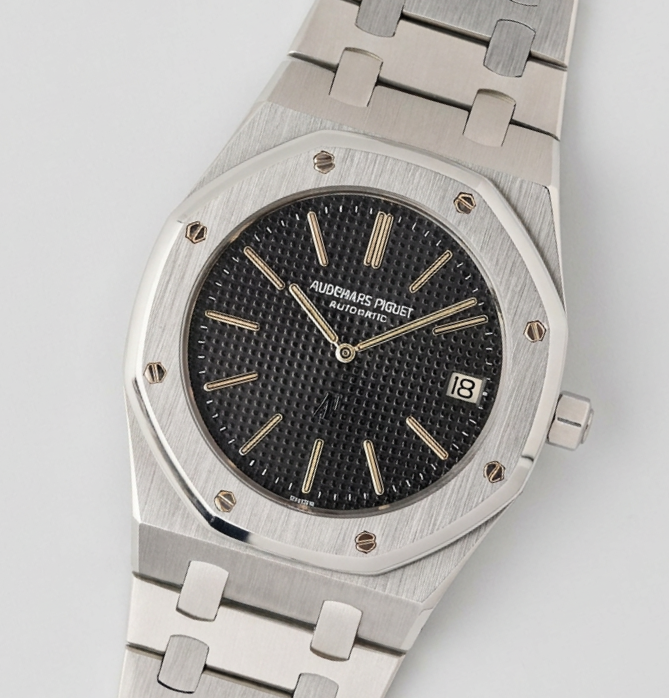
Presented in 1972 with reference 5402, the Royal Oak upended the industry's conventions: a 39 mm monocoque case with an octagonal bezel secured by eight hexagonal white-gold screws that visibly pass through the case (without touching the movement inside, still ensuring 100 meters of water resistance), a tapered integrated bracelet and the now-famous "Petite Tapisserie" pattern on the midnight-blue dial. Its launch price, CHF 3,300, was comparable to that of a gold watch of the era — a choice met with skepticism by retailers and customers alike, who struggled to understand how a steel watch could cost as much as a gold one.
The calibre 2121, an ultra-thin automatic movement just 3.05 mm thick with a peripheral rotor on ruby bearings, allowed for an equally thin case — an essential technical requirement to make the "luxury" ambition of a sports watch in a non-precious material credible. Initially slow, its success grew over the following years until the Royal Oak became the brand's most identifiable watch and a watershed moment for the entire history of luxury steel watchmaking.
The original 39 mm execution — informally nicknamed "Jumbo" as early as the 1970s, because at the time it seemed unusually generous for such a thin watch — has never truly disappeared from the catalogue for more than a few years: after a brief pause in the 1980s it returned with the 20th-anniversary edition (ref. 14802, 1992), then with ref. 15002 (1996) and above all with ref. 15202, produced continuously from 2000 to 2022. In 2022, for the model's 50th anniversary, Audemars Piguet presented ref. 16202, which replaces the historic calibre 2121 — unchanged since 1972 — with the new in-house calibre 7121, keeping the ultra-thin profile while raising the power reserve from 40 to 55 hours. For many enthusiasts and auction houses, this "Jumbo" line remains the collection's true "reference" Royal Oak, for its fidelity to Genta's original proportions.
Technical Specifications
Main Executions
According to the story passed down by the brand, Gérald Genta designed the entire Royal Oak in a single night after being challenged by CEO Georges Golay on the eve of the Basel watch fair: an almost legendary origin for one of the most copied and influential watches in the history of modern watchmaking. For fifty years, from 1972 to 2022, every "Jumbo" execution shared the same base calibre, the 2121 — a rare case in contemporary fine watchmaking, where movements are normally updated on a much shorter cycle.