

OttantaSei
Model History
The collaboration between Bovet and Pininfarina, the celebrated Turin automotive design house, took shape starting in 2007 and led in 2010 to the line's first watch: the Pininfarina OttantaSei Tourbillon, whose name — "ottantasei," Italian for eighty-six, referring to the brand's original colors — celebrates Pininfarina's eightieth anniversary. It is the first instance in which a major automotive design house co-signs an entire case and movement project with a watchmaking manufacture, not merely a styling exercise applied to an existing product.
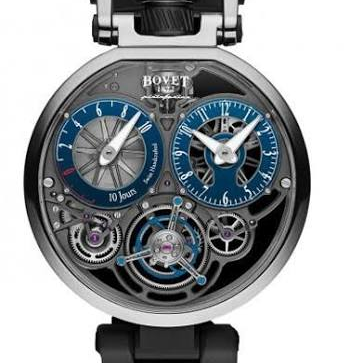
The result deliberately moves away from the baroque aesthetic and the references to nineteenth-century pocket watches that characterize the rest of the Bovet catalogue: the 44 mm case is almost entirely covered in sapphire — on the dial, the case back and the sides — to offer a continuous view of the mechanics, with a declaredly aeronautical inspiration recalling an aircraft or helicopter cockpit. Pininfarina's designers worked around the concept of "lightness," understood both as visual luminosity and as reduced weight on the wrist, imposing design constraints on the movement unusual for a high-end tourbillon.
To meet these requirements, Bovet's technicians developed two patented solutions: a spherical differential that halves the number of turns needed to wind the watch without increasing the required torque, and a three-dimensional gear-tooth system that reduces mechanical complexity while optimizing its operation. The result is a calibre capable of ten days of power reserve with a single barrel, set into a case that evenly distributes the space between time display, double-sided flying tourbillon and power reserve indicator, across three distinct registers.
Technical Specifications
Main Executions
The OttantaSei is among the very few pieces of high watchmaking born from an equal collaboration with an automotive design house from the case's design phase onward, not just its styling: Pininfarina, famous for designing Ferrari, Lancia and Alfa Romeo, applied to the watch the same aerodynamic study and volume-balancing criteria it uses for a car.