

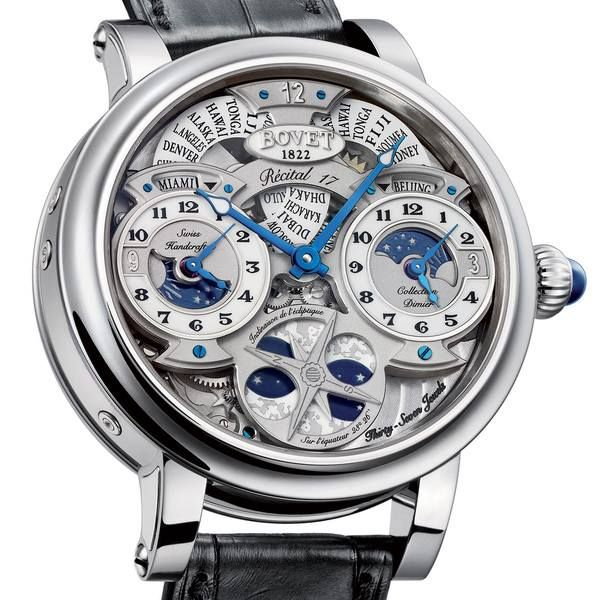
Récital
Model History
The Récital line has its roots in the Dimier sub-collection, introduced by Bovet in 2007 as a space dedicated to a more contemporary aesthetic, with the crown returned to its traditional position at 3 o'clock instead of 12 o'clock as in pocket-watch-inspired references. Within this stylistic framework, the first Récital was born between 2010 and 2012: a watch with a manual-wind tourbillon and a seven-day power reserve, a fully skeletonized dial leaving the mechanism visible, offered in 41 or 45 mm cases in 18-carat red gold.
From that first example, the Récital family grew into a numbered sequence of references progressively more ambitious in their complications: perpetual calendars, dual time zones, double-sided flying tourbillons, planetary mechanisms and hand-painted astronomical scenes. The high point of the series is arguably the Récital 22 Grand Récital, which in 2019 won the Aiguille d'Or, the top honor of the Grand Prix d'Horlogerie de Genève, thanks to a dial with hand-painted terrestrial hemispheres, a moon that follows their rotation and a double-sided flying tourbillon representing the sun. The brand calculates it has collected five GPHG awards in seven years from this line alone.
Alongside the most extreme executions, designed for high-watchmaking collectors, the line has progressively also embraced more accessible interpretations in size and price: the Récital 30, presented to bring Bovet's patented complex world-time system to a wider audience, reduces the diameter to 42 mm and adopts an in-house automatic movement, while keeping the technical and visual identity that defines the entire collection.
Technical Specifications
Main Executions
On the Récital 30, time-zone correction happens via two pushers: one rotates the world-time rollers 90 degrees at a time, the other advances the central 24-hour disc by one hour — a system also designed to handle time zones with half-hour offsets, such as New Delhi's, in addition to the usual switches between standard and daylight-saving time.