

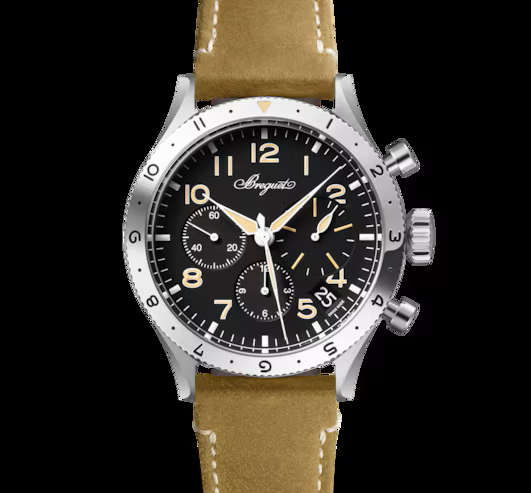
Type XX
Model History
The Type XX is born from a military specification: in 1952 the Service Technique Aéronautique of the French air force requests a pilot's chronograph with strict requirements, including a black dial with Arabic numerals, a 38 mm case, a bidirectional rotating bezel and, above all, a "flyback" function, allowing the chronograph to be reset and restarted with a single press, without having to stop, zero and restart it separately — a concrete need for pilots timing successive routes. Breguet delivers the first prototypes (numbered 1200-1202) in July 1952, and official production of reference 5101/54, with the Valjoux 222 calibre, begins in 1953-54: around 1,100 pieces are supplied to French military aviation between 1955 and 1959.
Alongside the military version, a civilian variant appears as early as 1955, reference 1888, recognizable by the added 12-hour counter on the dial. In the following decades the calibre evolves — from the Valjoux 222/225 to the 230/720 with Incabloc shock protection, and then the 235/725 — while the name "Type XX" (or "Type 20", the generic designation the French air force also used for chronographs from other suppliers) becomes synonymous, in the vintage collecting market, with the quintessential aviation chronograph.
The line's modern revival passes through reference 3800/3820 (1996-2004, Lemania 582 calibre), the Type XXI 3810 of 2004 (a more generous 42 mm case, day/night indicator) and the Type XXII 3880 of 2010, with a 10 Hz high-frequency balance wheel. The most recent chapter arrives in 2023 with a fourth generation, the Type 20 Chronographe 2057 and the Type XX Chronographe 2067: in-house manufacture calibres 7281 and 728, entirely developed internally, with column wheel, vertical clutch and silicon balance spring, bringing the original flyback function to a fully contemporary architecture.
Technical Specifications
Main Executions
"Type XX" was not originally an exclusive Breguet commercial name, but the generic designation French military aviation used to identify the category of pilot's chronographs requested from multiple suppliers in the 1950s (including Dodane, Vixa and Auricoste): over time, however, it was Breguet's interpretation that remained the most celebrated, and it still lends its name today to an entire collection.