

Accutron
Model History
The Accutron is presented by Bulova on 25 October 1960 and reaches the market the following year, the result of the work of Swiss engineer Max Hetzel: instead of the oscillating balance wheel of a mechanical watch, the calibre 214 uses an electronic tuning fork vibrating at 360 Hz, driven by a transistor circuit and powered by a battery. Instead of the ticking of a mechanical movement or the sharp tick of a quartz, the Accutron produces a characteristic continuous hum — its most recognizable trait even to someone not wearing it — which has become an integral part of the model's identity. The name itself, a blend of "accuracy" and "electronic", sums up the project's ambition: to offer a precision until then unknown to wristwatches, which Bulova advertised as guaranteed within one minute a month.
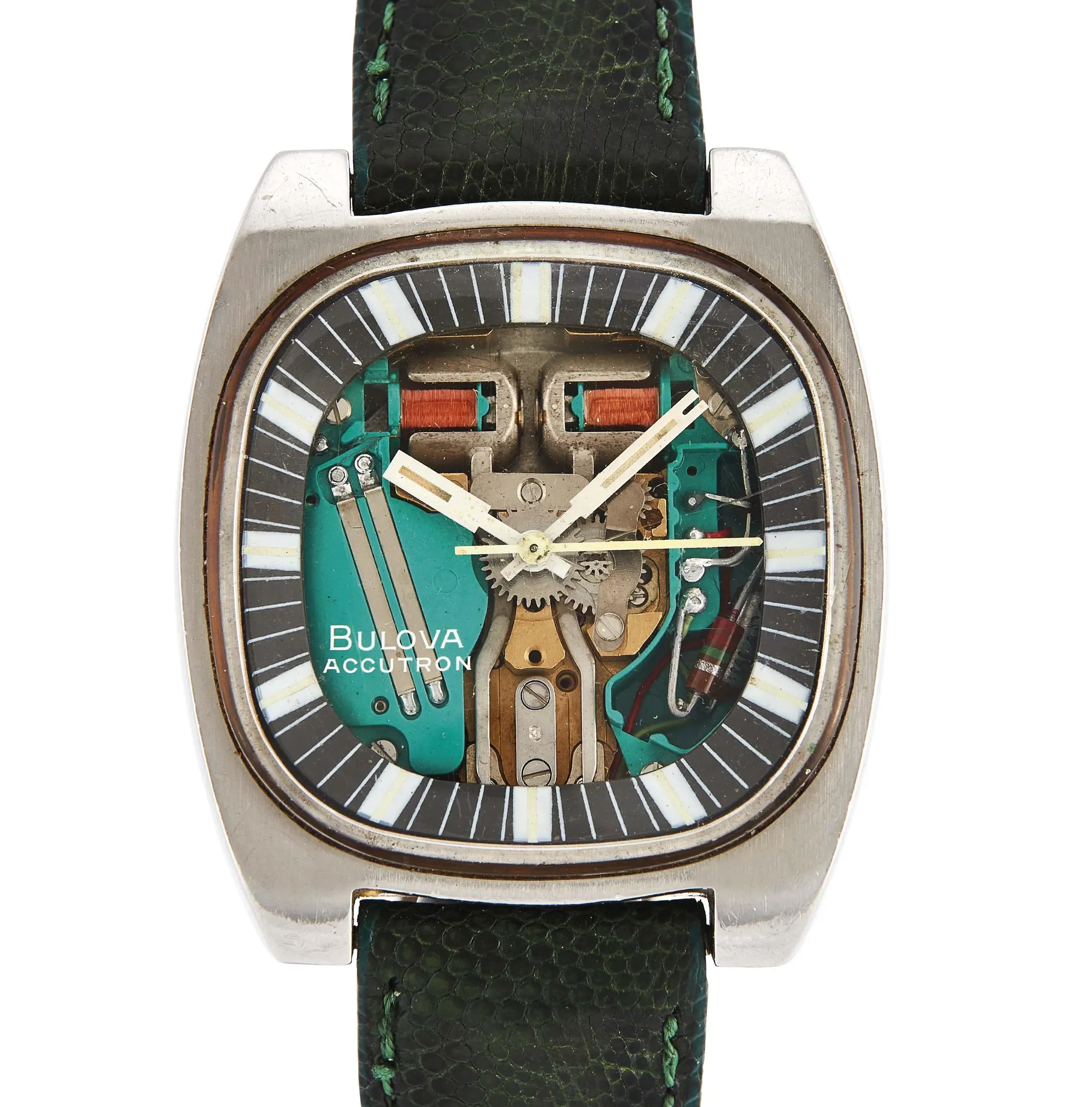
Commercial success was immediate: it is estimated that over four million pieces were sold by 1973. But it is the "Spaceview" variant, with an open dial lacking traditional indices, that becomes the line's most recognizable image: leaving the vibrating tuning fork and the complex system of toothed wheels on display, it turned a technical detail into an aesthetic statement. Born almost by chance — legend has it that the first open-dial piece was a test-bench prototype later requested by a customer — the Spaceview is today the most sought-after Accutron model among collectors and has become, more broadly, one of the recognizable symbols of vintage American electronic watchmaking.
The Accutron's bond with the history of space exploration is one of the most cited aspects of its legacy: movements derived from the calibre 214 were used as onboard chronometers in several NASA missions, from the Mercury and Gemini programs to Apollo, and an Accutron tuning-fork device was even left on the lunar surface as part of the Apollo program's scientific instrumentation. Production of the original line continued until the late 1970s, before being replaced by quartz technology.
The vintage Accutron remains today one of the most closely followed categories in watch collecting, with an active market around the calibre 214 and the later 218/219 evolutions: it is the original Spaceview pieces, together with more particular references such as the "Astronaut", that fetch the highest prices. It is an interest Bulova itself has acknowledged by bringing the name back into production under the Accutron brand: the Spaceview 2020, with an entirely new electrostatic calibre, openly takes up the aesthetic language of the 1960 original — open dial, green accents, orange seconds hand — showing just how much the Accutron's appeal still today remains tied, first and foremost, to the historic pieces.
Technical Specifications
Main Executions
The Accutron's tuning fork did not just keep time on the wrist: electronic devices derived from the same principle were also used as timing components in scientific instrumentation carried by the Apollo missions, a little-known detail that ties the Bulova name even more closely to the history of lunar exploration, well before the famous episode of Dave Scott's chronograph on Apollo 15.