

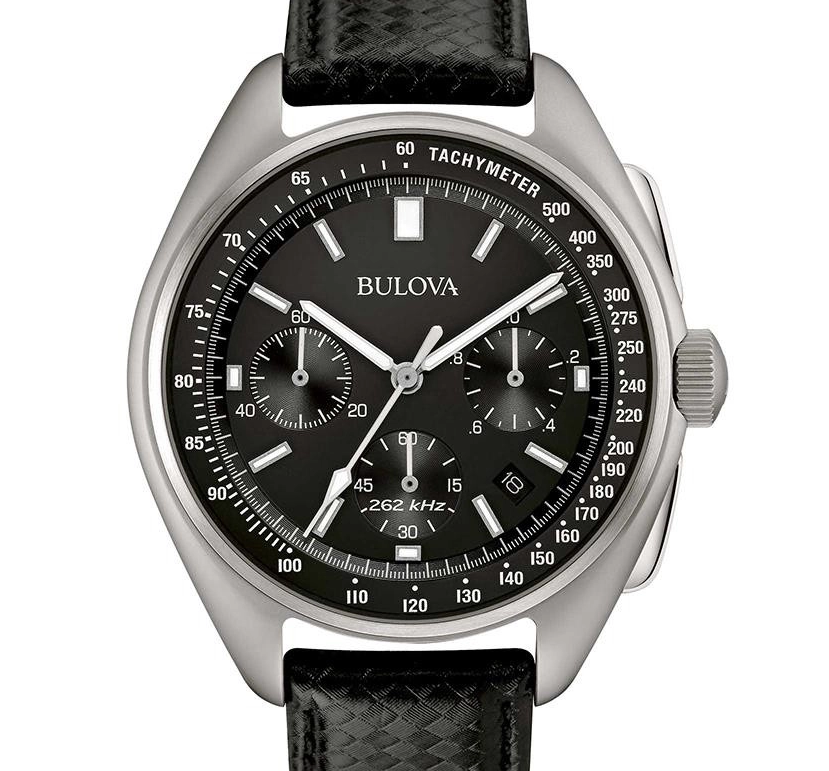
Lunar Pilot
Model History
In 1971 Bulova gives a personalized mechanical chronograph to Dave Scott, commander of the Apollo 15 mission, made with a case designed to withstand extreme swings in pressure, temperature and gravity. Scott wears it as a backup watch alongside the official one supplied by NASA; when the latter's crystal is damaged during the mission, it is the Bulova chronograph that ends up on his wrist during the moonwalk on the lunar surface, becoming — according to several sources — the first privately owned watch, not supplied by the space agency, to have actually touched the lunar surface. The original piece, kept for decades in the astronaut's personal collection, was auctioned in 2015 for over 1.6 million dollars.
In 2016 Bulova turns this episode into a dedicated commercial collection, the Lunar Pilot Chronograph: a 45 mm barrel-shaped steel case recalling the proportions of the original watch, a dial with three counters at 3, 6 and 9 o'clock and a tachymeter scale on the flange. The heart of the project, however, is the movement, the Bulova calibre NP20: an ultra-high-frequency quartz (262 kHz) that allows the chronograph's seconds hand to sweep continuously and smoothly, instead of the classic one-second jump typical of traditional quartz, bringing the movement aesthetically closer to a mechanical chronograph.
In 2023 the line is enriched with a "Reimagined" version, with a case reduced to 43.5 mm, closer to the actual proportions of the chronograph worn by Scott in 1971, while keeping the same NP20 calibre and the general dial layout. The Lunar Pilot remains today one of the collections most explicitly tied to the brand's space history, alongside the more technical legacy of the Accutron.
Technical Specifications
Main Executions
Unlike Omega's celebrated "Moonwatch", officially certified by NASA for its astronauts, the Bulova chronograph reached the Moon through an unofficial, fortuitous circumstance: a simple personal gift that, due to an unforeseen failure of the mission watch, still ended up writing a page in the history of space exploration.