

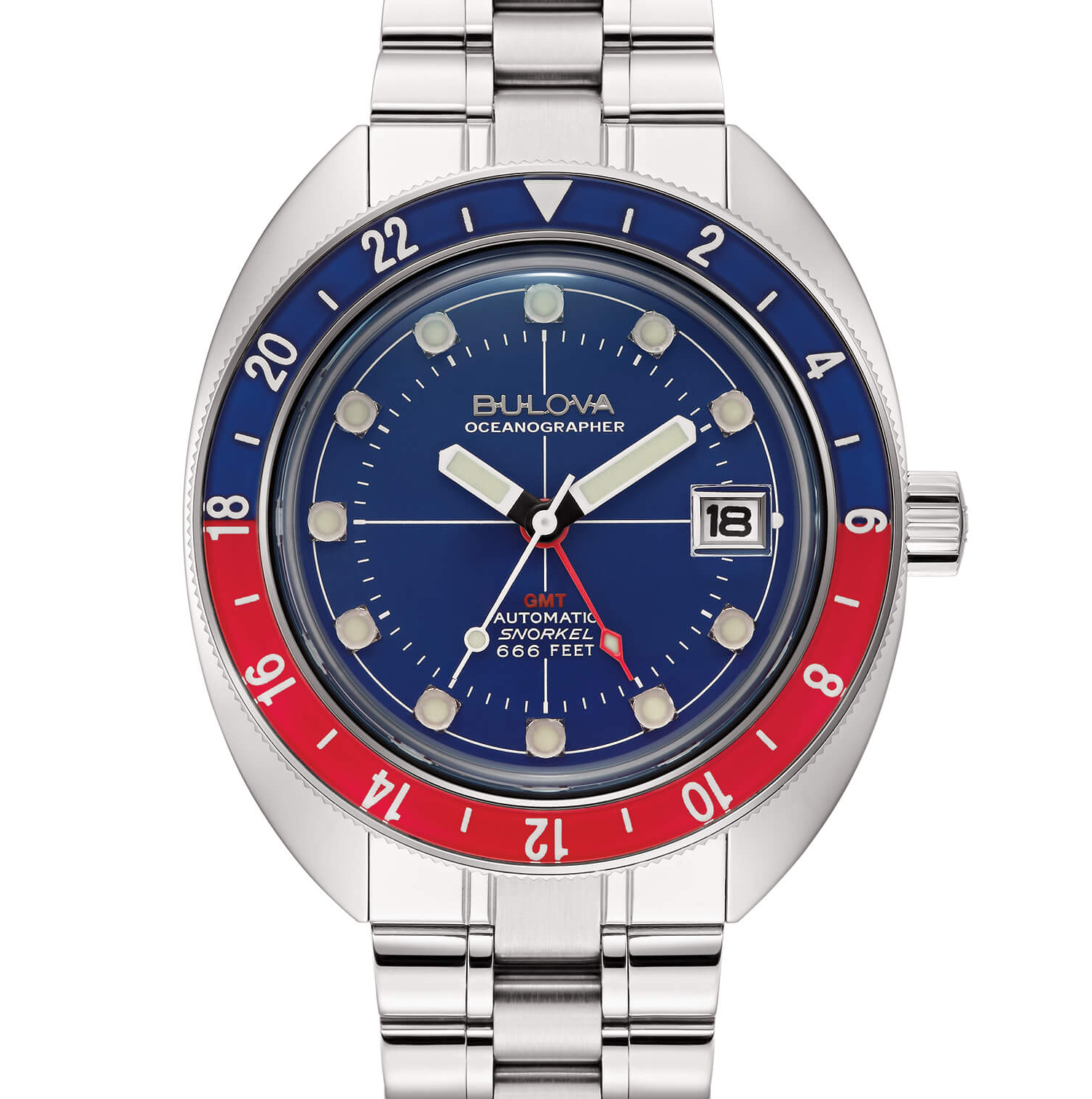
Oceanographer
Model History
In 1961 Bulova presents its first watch designed specifically for underwater use, mounted on a "Compressor"-type case supplied by the Swiss company Ervin Piquerez SA (EPSA), the same watertight technology adopted in those years by several other brands for their diving watches. What set the Bulova watch apart from the competition, however, was a bold marketing choice: while standard Compressor cases were rated water resistant to 600 feet, Bulova pushed the figure to 666 feet (around 200 meters), the "number of the beast" cited in the biblical Book of Revelation — a deliberately provocative association that earned the watch the nickname, still widespread among collectors today, of "Devil Diver".
"Devil Diver" is actually an umbrella name collectors use for the entire family of Bulova diving watches rated to 666 feet, which appeared over the course of the decade in several near-twin variants — Deep Sea, Surfboard and, above all, Snorkel. The latter debuts in late 1968 with a "bullseye" dial featuring three-dimensional indices coated with tritium luminescent material and a two-tone bezel with the first fifteen minutes highlighted in red, useful for timing decompression stops during dives. The name "Snorkel" recalls its declared intended use by Bulova: a watch designed for snorkeling and free-diving rather than deep professional diving, which allowed the case to be kept compact (about 36 mm) compared with the competition's "working" dive watches. Produced until the mid-1970s in several references — including the 386-1 and 386-3, among the most cited today by collectors and auction houses — the Snorkel rapidly became the most widespread and recognizable variant of the entire Devil Diver family, to the point of often being the name collectors use to identify the whole line today.
It is in 1969, on the same case and dial layout inherited from the Snorkel, that the name "Oceanographer" appears for the first time alongside the Bulova logo: from that moment it becomes the official designation of the entire line, while "Devil Diver" and "Snorkel" remain the nicknames by which collectors best know it. Some references in the family were also fitted with the Accutron tuning-fork calibre, combining the rugged diver aesthetic with the electronic precision that in that same period was making Bulova famous. Vintage pieces from the late 1960s and 1970s are today among the most sought-after Bulova diving watches among collectors: relative rarity is joined by an all-steel construction (not plated), a distinctive design — rounded "Compressor" case, bullseye dial, three-dimensional indices — with no real equivalent among contemporary diving watches from other brands, and the slightly provocative appeal of the 666-foot rating. It is a demand Bulova itself continues to fuel by bringing the model back into production: from the Archive Series reissue, faithful to the 1970 design but with updated movement and materials, to the more recent Snorkel collection with hybrid ceramic cases — confirming just how much the vintage name remains the line's true asset today.
Technical Specifications
Main Executions
The number 666 on the dial was neither an error nor a stylistic whim, but a calculated marketing choice: Bulova was well aware it recalled the "number of the beast" from the Book of Revelation, and openly played on that ambiguity to make its diver memorable compared with the competition, which prudently stopped at 600 feet.