

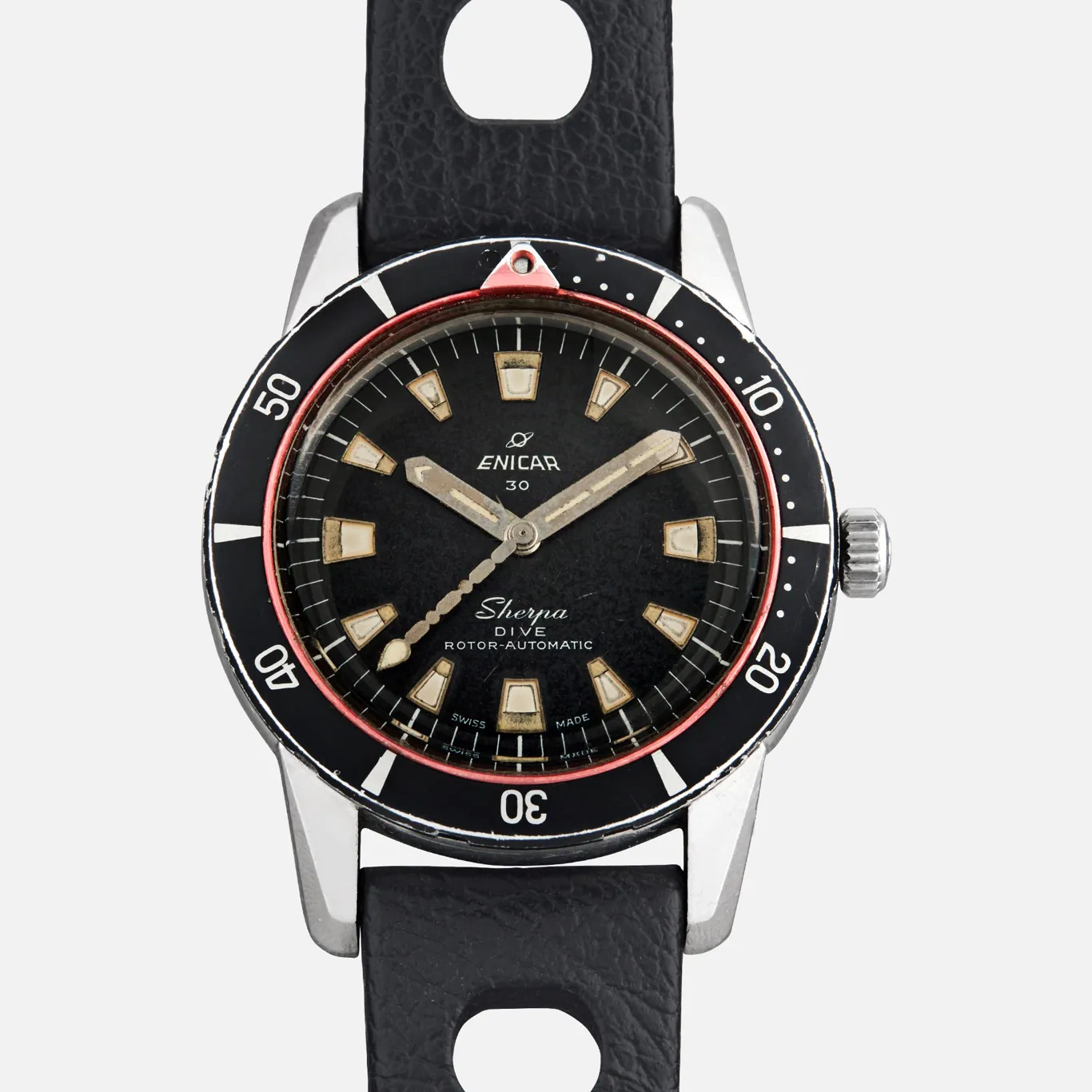
Model History
The Sherpa name was registered by Enicar on 6 November 1956, shortly after Swiss mountaineers wore Enicar watches during the Everest and Lhotse expeditions. The Sherpa Dive line followed soon after, with the Super-Divette, a 36mm model that counts among the first watches purpose-built for diving.
The defining technical feature of the Sherpa Dive family was the case supplied by EPSA (Ervin Piquerez SA), known as the "Super Compressor." Rather than a single rotating bezel, the case used a second crown that rotated an internal graduated ring, allowing a diver to time an immersion while keeping the case sealed. Inside, Enicar fitted its own automatic caliber 1145 and 1145B family, running at 18,000 vibrations per hour and protected by an Incabloc shock-absorbing system.
The most sought-after reference among collectors today is the Sherpa Ultradive, ref. 144/35/03, dating from around 1966. At 43mm it was large for its era, with an asymmetric crown guard, a black dial, and a red date disc — details that still make it one of the most recognizable Enicar sport watches. In 1957 the brand staged a memorable publicity stunt, attaching a Sherpa Ocean Pearl to the hull of the Mayflower II replica during its Atlantic crossing to demonstrate the watch's water resistance.
Technical Specifications
Main Executions
In 1957 Enicar attached a Sherpa Ocean Pearl to the hull of the Mayflower II replica for its entire Atlantic crossing, using the voyage as a real-world water resistance test and publicity stunt.