

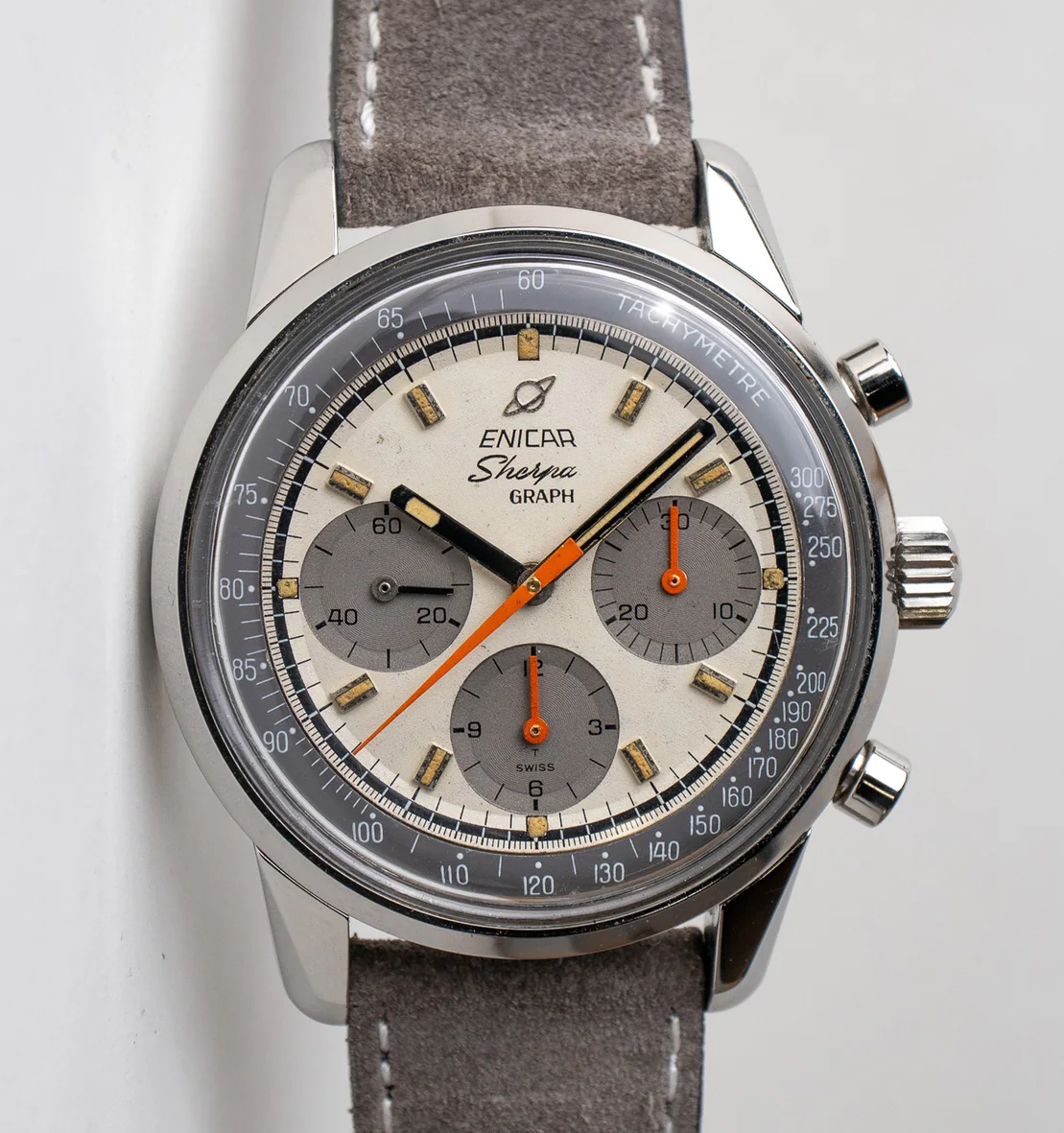
Model History
The Sherpa Graph was introduced in 1960 as the chronograph member of the Sherpa family. It paired a manual-wind Valjoux 72 movement, a bicompax layout with a 30-minute counter and a 12-hour counter, with the same waterproof Super Compressor case used across the Sherpa line, supplied by EPSA. At a time when most racing-oriented chronographs made little effort toward water resistance, building one into a genuinely sealed case was unusual for the segment.
Later series carried the EPSA "Saturn" logo on the crown, a small detail collectors use to help date individual pieces. Production ran through much of the 1960s, and collectors today classify surviving examples into four broad generations, Mark I through Mark IV, with reference 072-02-01 among the most commonly cited.
Like the rest of the Enicar range, the Sherpa Graph declined along with the brand through the 1970s as the quartz crisis reshaped the Swiss watch industry, eventually leading to Enicar's 1987 insolvency.
Technical Specifications
Main Executions
The Sherpa Graph's waterproof chronograph case was a genuine engineering outlier for its category in the early 1960s, when most racing chronographs offered little real protection against water.