

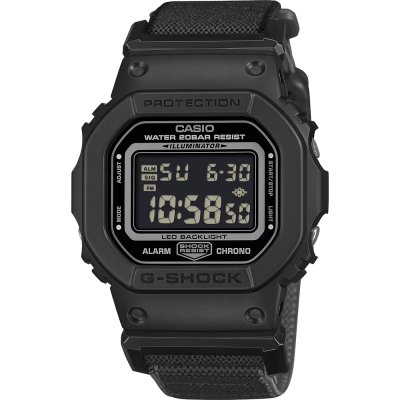
Model History
Origin is the name Casio now uses to group the family of models descended directly from the very first G-Shock. It all began in 1981, when engineer and designer Kikuo Ibe formed a small group inside Casio informally called the "Project Team Tough", with the stated goal of building a watch able to survive a ten-meter fall, remain waterproof and keep working without breaking. The idea was personal: as a boy, Ibe had received a watch as a gift from his father and broken it by dropping it in the street, an episode that stayed with him for years.
For about two years the team faced a seemingly unsolvable problem: every time one point of the case was reinforced, another component would fail during testing. Ibe himself threw the prototypes out of the second-floor restroom window of the Casio offices, destroying more than 200 of them before finding the solution. The breakthrough came while watching a child playing with a rubber ball in a park: from that image came the idea of a "floating" module inside a hollow case, protected by layers of shock-absorbing material instead of being rigidly fixed — the "floating module structure" principle that still shapes every G-Shock today.
The DW-5000C, launched in Japan in April 1983 in black/red and black/gold variants, was the first result of this work: an octagonal case, a stated water resistance down to 200 meters, and a long-lasting battery. Domestic sales were initially modest; success came the following year, when the DW-5200 model starred in a US television commercial that showed it surviving a hockey puck. In 1987 the shape was definitively settled with the DW-5600, which has remained in production ever since with virtually no substantial changes, becoming the brand's most recognizable silhouette and the basis from which, decades later, the all-metal GMW-B5000 version was also born.
Technical Specifications
Main Executions
To validate shock resistance, Kikuo Ibe personally tested the prototypes by throwing them out of his office's second-floor restroom window at the Casio plant: a homemade method that, by his own account, cost him more than 200 destroyed units before arriving at the definitive DW-5000C.