
Girard-Perregaux
Brand History
Girard-Perregaux claims 1791 as its founding year, placing it among the oldest continuously active Swiss watchmaking manufactures in existence: it is the year in which Geneva-born Jean-François Bautte signed his first watches and started a manufacture that brought together under one roof all the trades needed for production — an unusual choice for the time, when work was normally scattered among independent craftsmen (the so-called établisseurs). The name we know today, however, was born later and elsewhere: in 1852 watchmaker Constant Girard founded Girard & Cie in La Chaux-de-Fonds, and in 1854 he married Marie Perregaux, daughter of another watchmaking family from the region. From the union of the two names and the two professional legacies, the Girard-Perregaux manufacture was born in the mid-1850s. The two histories — Bautte's in Geneva and Girard's in La Chaux-de-Fonds — definitively merged in 1906, when Constant Girard-Gallet acquired the Bautte maison and incorporated it into Girard-Perregaux & Cie, giving historical continuity to the founding date the brand claims today.
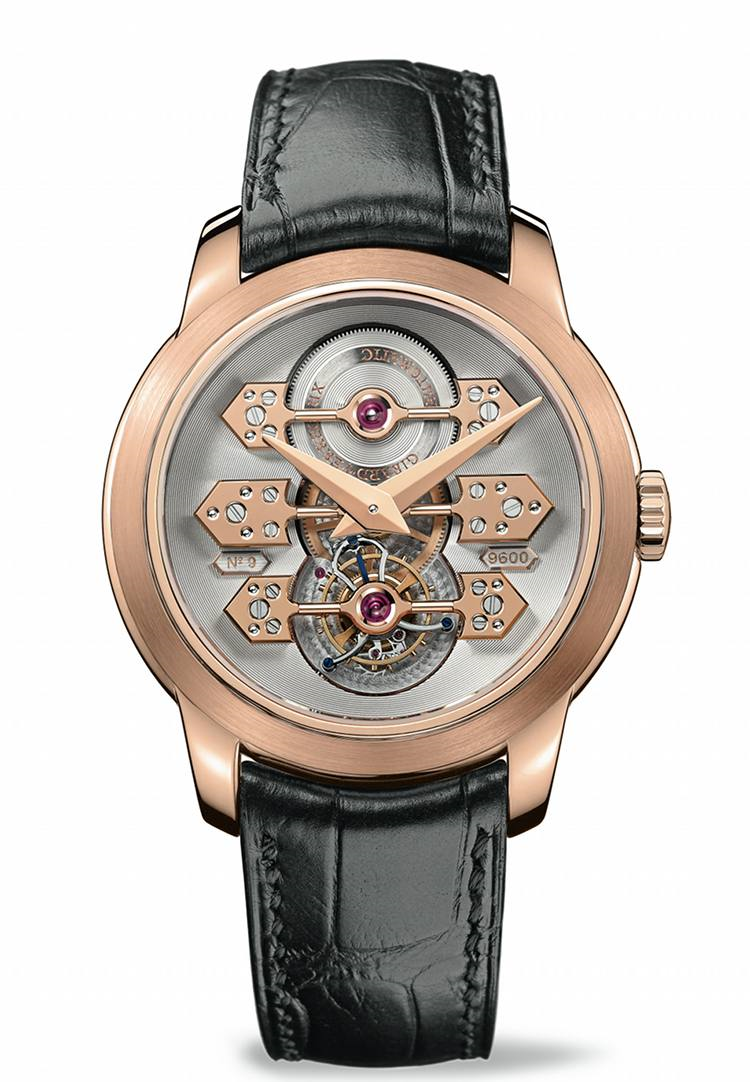
Constant Girard's most celebrated contribution to watchmaking history dates, however, to the 1860s, when he developed an entirely original tourbillon architecture: instead of hiding the mechanism under a single bridge, he aligned the barrel, going train and tourbillon cage under three parallel, arrow-tipped bridges, in gold. The solution, presented at the Neuchâtel Observatory and at international exhibitions, achieved record-setting chronometric results for the era and was patented in the United States in 1884. The moment of greatest consecration came in 1889, when a pocket watch built on this architecture — later renamed "La Esmeralda" after the name of the boutique that displayed it in Paris and Mexico City — won the gold medal at the Paris World's Fair, the same event that saw the inauguration of the Eiffel Tower. According to tradition handed down by the Manufacture, the original piece belonged to General Porfirio Díaz, then president of Mexico, before being bought back by the House for its own historical collection. The design of the three gold bridges, as technical as it is theatrical, has since become the manufacture's visual signature, to the point of being echoed, in stylized form, in Girard-Perregaux's own logo: few watch brands in the world can say their graphic symbol is, literally, a patented mechanical component. Production of the three-bridge architecture stopped in 1911, upon Constant Girard's death, resuming only seventy years later, in 1980-1981, with a series of twenty pocket pieces faithful to the original design; in 1991, for the Manufacture's bicentennial, the first wrist version arrived, followed in 2016 by a new Esmeralda for the brand's 225th anniversary.
Throughout the twentieth century the Manufacture continued to stand out for technical innovation as much as for its historical heritage alone. In the 1950s engineer Jean-Pierre Graef developed the automatic calibers of the Gyromatic family; in 1965-66 Girard-Perregaux presented what is described as the first high-frequency mechanical movement in history, with a balance wheel beating at 36,000 vibrations/hour, awarded the following year by the Neuchâtel Observatory on the occasion of its own centenary. A few years later the House also played a pioneering role in the quartz revolution: in 1970 it presented a first wristwatch prototype, and in 1971 it adopted an oscillation frequency of 32,768 Hz that would, within a few years, become the worldwide standard for the entire quartz watch industry, Swiss and otherwise. On the corporate side, Girard-Perregaux joined the Sowind group in the late 1980s, relaunched from 1992 by Italian entrepreneur Luigi Macaluso; in 2011 Sowind became a subsidiary of the French luxury group Kering, which in 2022 sold its stake through a management buyout that returned the manufacture to independent leadership, today entrusted to chief executive Patrick Pruniaux. The headquarters has remained, for over two centuries, in La Chaux-de-Fonds, in the Jura Arc, the historic heart of Swiss watchmaking.