

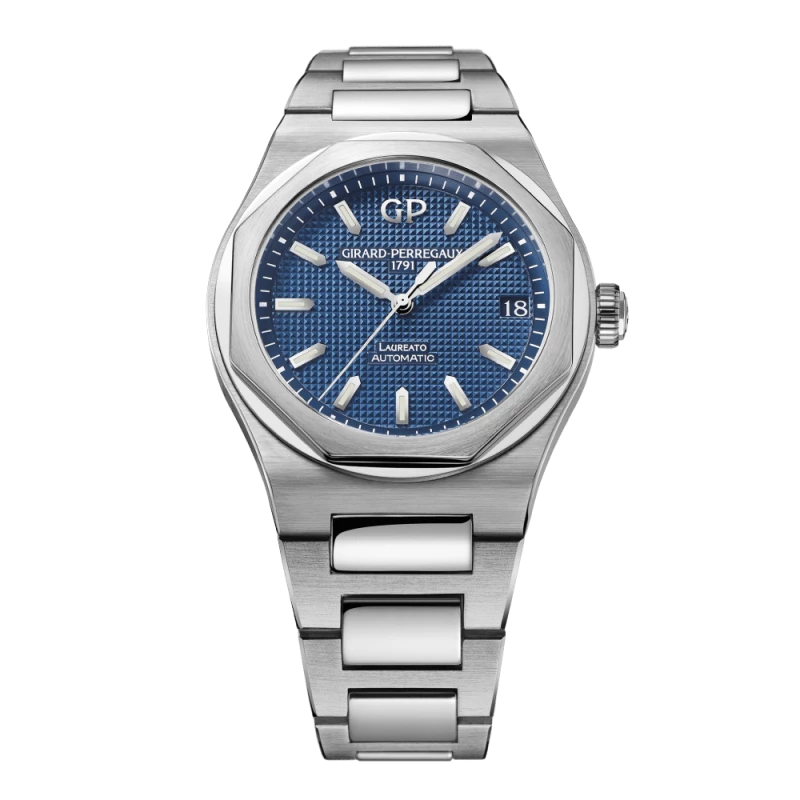
Laureato
Model History
The Laureato was born in 1975, in a decade when the Swiss high-end watch industry was experimenting with steel cases and integrated bracelets as a new language for sporty elegance, in response to quartz competition and an audience asking for watches that were as refined as they were wearable every day. For the project, Girard-Perregaux chose an octagonal bezel — a stylized evocation of a laurel wreath, consistent with the chosen name — and a bracelet that continues the line of the case without interruption, according to the Manufacture's in-house team, which claims a design developed, engineered and made entirely in-house. The name "Laureato," an unusual Italian word for a Swiss watch, evokes ideas of success, recognition and achievement: according to the House, the intention was not to create "just a watch, but a vision." The first executions, consistent with the technical spirit of the time, were fitted with high-precision quartz movements.
In the following years the Laureato went through several relaunch phases without ever truly leaving production. In 1995, for the line's twentieth anniversary, Girard-Perregaux reintroduced it with an in-house automatic caliber, the GP3100, marking the definitive shift from quartz to mechanics as the heart of the collection's identity. In 2005 a third case evolution arrived, the Evo3, with a sportier character and proportions updated to contemporary taste. The most recent turning point dates to 2016, when, for the brand's 225th anniversary, the Laureato was relaunched with a new automatic caliber, the GP3300, becoming the following year a permanent collection structured across multiple diameters — from smaller models aimed at a female audience up to the 42 mm of the most iconic reference — rather than a single occasional line.
Today the Laureato coexists, in the Manufacture's catalog, with the historical legacy of the Tourbillon with Three Gold Bridges, and the two icons have been made to speak directly to each other: the 2020 Laureato Absolute Light reference, with an entirely sapphire case, and above all the Laureato Three Gold Bridges, which fits the proprietary three-gold-bridge GP9620 caliber inside the octagonal case, show how the brand uses its most recent sporty language as a vehicle for its oldest technical heritage. It is a path that makes the Laureato, fifty years after its debut, no longer just a product of its era but the reference collection of the entire Manufacture.
Technical Specifications
Main Executions
The name "Laureato" is not a technical term or a geographic reference, as was customary for many Swiss sports collections of the era, but an Italian word that literally means "one who has earned a degree": an unusual communication choice, meant to evoke an idea of achievement and recognition rather than a technical feature of the watch. Interestingly, the very octagonal bezel that defines the line today is described by the Manufacture as a stylized evocation of a laurel wreath, consistent with the chosen name.