

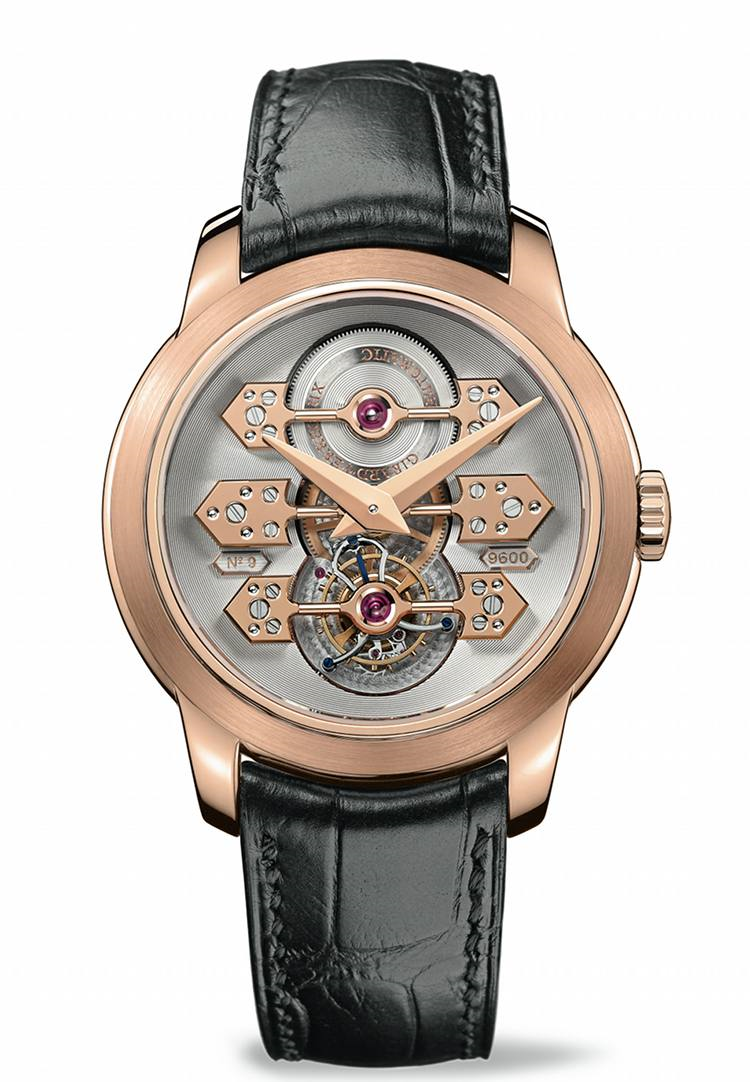
Tourbillon with Three Gold Bridges
Model History
In the 1860s Constant Girard developed a tourbillon architecture unlike any convention of the time: instead of hiding the mechanism under a single bridge, as practice dictated, he aligned the barrel, going train and tourbillon cage under three parallel, arrow-tipped bridges, made of gold. The choice was not merely aesthetic — each bridge isolates and protects a distinct functional group, improving accessibility and adjustment — but immediately became a visual manifesto too: for the first time the watch's regulating heart, instead of being concealed, was put on display. Presented with record-setting chronometric results at the Neuchâtel Observatory, the invention was filed as a patent in the United States in 1884, formalizing a design that has since carried the Manufacture's name around the world.
The moment of consecration came in 1889, when a pink-gold pocket piece built on this architecture won the gold medal at the Paris World's Fair — the same event that saw the inauguration of the Eiffel Tower. The piece was later renamed "La Esmeralda," after the Paris and Mexico City boutiques where it was displayed and sold. According to tradition handed down by the House, the piece belonged to General Porfirio Díaz, then president of Mexico, before being bought back by the Manufacture for its own historical collection. Production of the three-bridge complication stopped, however, in 1911, upon Constant Girard's death: for seventy years the architecture remained a closed chapter, preserved only in the House's museums and archives.
The revival came between 1980 and 1981, when Girard-Perregaux produced a series of twenty pocket watches faithful to the original design — a reconstruction effort that, for the first piece, required, according to the Manufacture, more than 1,500 hours of work. In 1991, for its own bicentennial, the House presented the first wrist version of the complication, bringing the three gold bridges to the wrist for the first time instead of the pocket. Since then the architecture has been reinterpreted several times, up to the new white-gold Esmeralda presented in 2016 for the brand's 225th anniversary, confirming this invention's role as the Manufacture's permanent technical and aesthetic signature — to the point of being echoed, in stylized form, in Girard-Perregaux's own logo.
Technical Specifications
Main Executions
Very few watch brands in the world can say their graphic symbol is, literally, a patented mechanical component: the Girard-Perregaux logo still today depicts the stylized silhouette of the three parallel bridges designed by Constant Girard in the 1860s. A separate curiosity about the original 1889 piece holds that it belonged to General Porfirio Díaz, then president of Mexico — consistent with the name "La Esmeralda" itself, taken from the Paris and Mexico City boutiques where the piece was displayed and sold.