

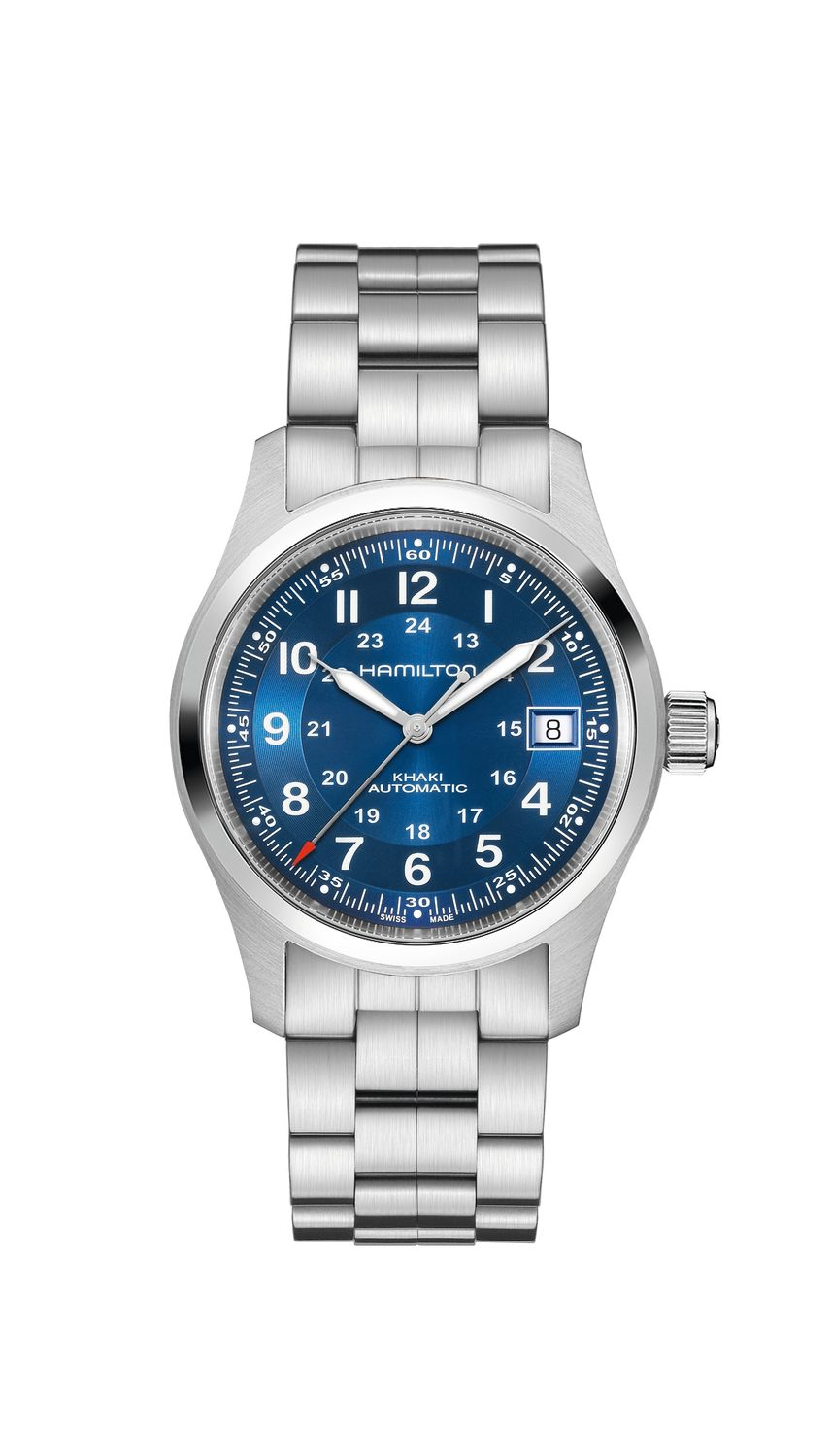
Khaki Field
Line History
The origins of the Khaki Field go back to the First World War, when Hamilton began converting its pocket calibers into wristworn "trench watches" for American soldiers at the front. It was with the Second World War, however, that the bond between Hamilton and the field watch became structural: from 1942 to 1945 the company entirely suspended civilian production to supply the Allied troops with over a million watches, earning five Army-Navy "E" Awards for the quality of its wartime production.
The look that still defines the Khaki Field today, however, emerged later, from US military specifications of the Vietnam era: the 1962 MIL-W-3818B and the subsequent 1964 MIL-W-46374 set the requirements for the regulation field watch — accuracy within 30 seconds a day, a hacking seconds function, resistance to water and magnetism, a manual-wind mechanical movement with at least 17 jewels. From these standards come the black dial with white Arabic numerals, the inner 24-hour scale and the triangular indices that have become the recognizable visual language of the line.
Between the 1980s and 1990s Hamilton began offering this military aesthetic to civilian customers as well, distributing the first Khaki Field models through catalogs such as L.L. Bean and Orvis. Today, under the Swatch Group, the collection numbers dozens of references — from the manual-wind Khaki Field Mechanical to the automatic Khaki Field Auto, through to titanium variants and the Khaki Field Auto Chrono chronograph — while maintaining an accessible positioning despite being made entirely in Switzerland; in 2026 the brand also dedicated a special edition of the Khaki Field Mechanical to the 250th anniversary of US independence.
Technical Specifications
Main Executions
In the 1980s and 1990s the Khaki Field reached American civilian customers through outdoor clothing catalogs like L.L. Bean and Orvis, well before becoming a recognized reference among watch enthusiasts: an unusual path that helped make the line one of the best-selling field watches in the world, able to stay accessible despite being built entirely in Switzerland.