

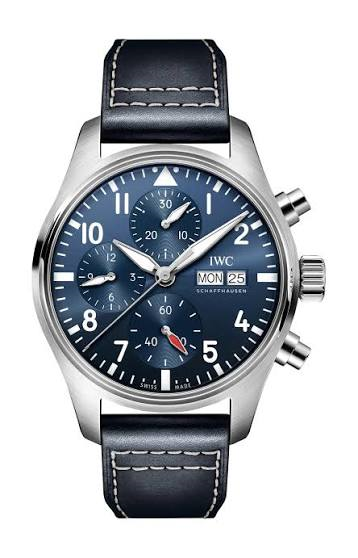
Pilot's Watch
Model History
IWC's aviation calling began in 1936 with the Special Pilot's Watch (reference 436): a 38 mm case designed for maximum legibility under extreme conditions, fitted with an antimagnetic movement and developed with the help of in-house technicians who held pilot's licenses. It was the first step on a path that would place IWC, together with a handful of other Swiss and German manufactures, among the leading names in flight watchmaking. During the Second World War, IWC was one of five manufacturers (alongside A. Lange & Söhne, Wempe, Stowa and Laco) commissioned to produce the Beobachtungsuhren, the "observation watches" required by the German aviation ministry: reference 431, introduced in 1940, remains to this day the largest wristwatch IWC has ever made, at 55 mm in diameter and 183 grams in weight, with around 1,000 pieces produced for military use.
In the postwar period the line was refined for chronometric precision: in 1948 the Mark 11 was born, a chronometer-grade watch supplied to the British Royal Air Force and kept in active service for decades, protected by an inner soft-iron cage shielding the movement from magnetic fields — a constructive principle IWC would also apply to other lines, such as the Ingenieur.
The line's most recognizable chapter arrived in 2002, when IWC relaunched the Big Pilot's Watch with reference IW5002: a modern 46 mm reinterpretation of the 1940 design, fitted with an automatic movement with 7 days of power reserve and antimagnetic shielding up to 32,000 A/m. Its cone-shaped crown, oversized so it could be operated even while wearing flight gloves, has since become the defining feature of the entire Pilot's Watch family.
Technical Specifications
Main Executions
The Second World War Beobachtungsuhren were made only by five manufacturers authorized by the German aviation ministry: A. Lange & Söhne, Wempe, Stowa, Laco and IWC. Despite construction differences between the various makers, all had to meet the same strict military specifications for legibility and precision — a chapter of watchmaking history that still links, if only indirectly, brands that are today very different from one another.