

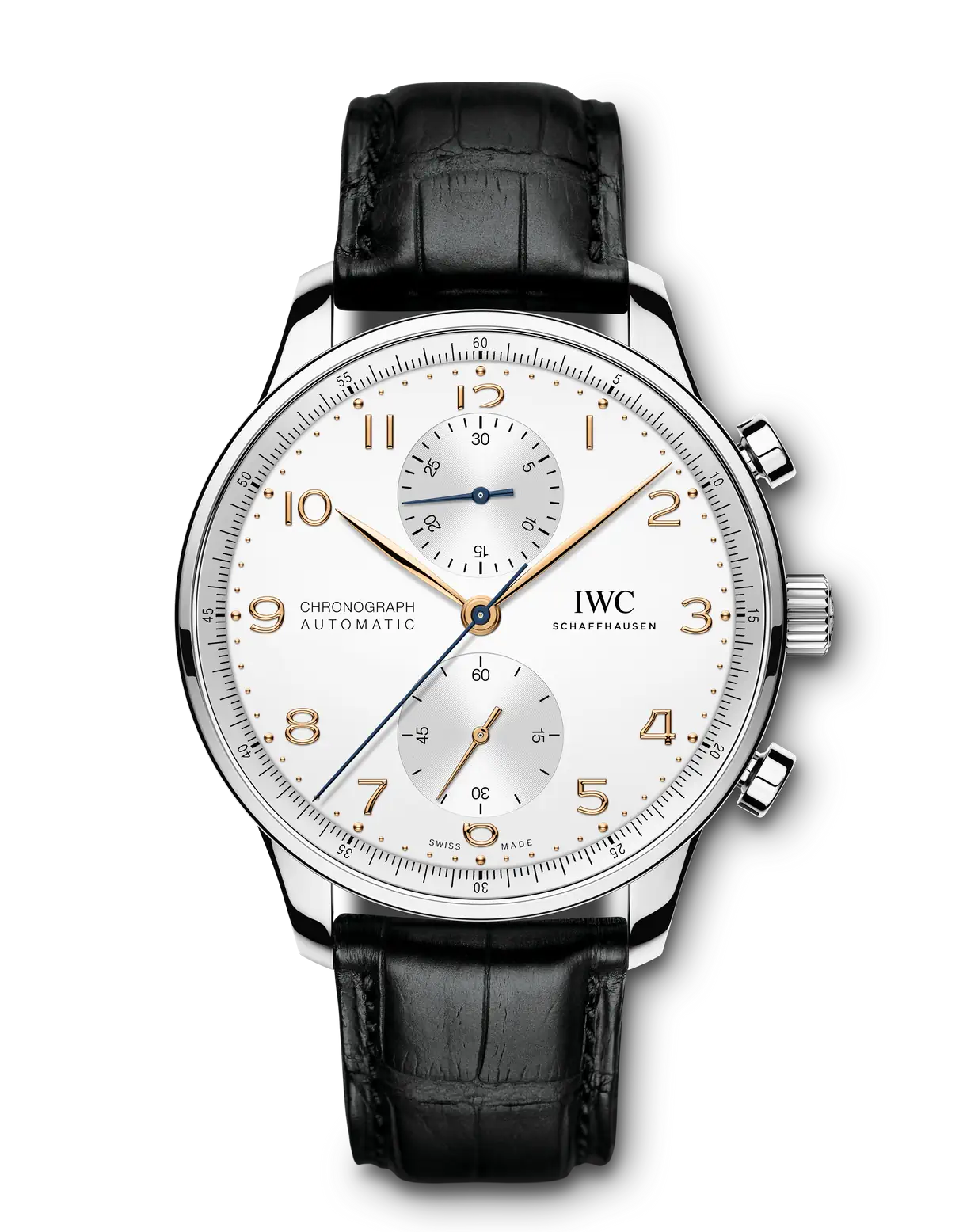
Portugieser
Model History
The Portugieser was born in 1939 from an unusual request: Portuguese wholesalers Rodrigues and Teixeira approached IWC asking for a wristwatch capable of the same precision as a marine chronometer. To meet it, IWC turned to a pragmatic rather than stylistic solution: it used the large pocket-watch movements already in its catalog (calibers 74 and 98), housing them in a wristwatch case unusually large for the time, around 41.5 mm. This gave rise to reference 325 — catalogued internally as model 228 — of which only 690 pieces in total were ever made, across three variants: the first deliveries, in February 1939, paradoxically reached a Ukrainian wholesaler before the model ever truly arrived in Portugal, where only a handful of units would circulate for decades.
For more than fifty years the Portugieser remained a niche model, nearly forgotten. The turning point came in 1993, when, for the brand's 125th anniversary, IWC relaunched it with reference 5441, the "Portugieser Jubilee": a 42 mm case and manual-winding caliber 9828, with a clean silver (argenté) dial, recessed small seconds, a railway-track minute scale and large raised Arabic numerals — the aesthetic framework that still defines the collection today.
The following years saw the line expand with increasingly ambitious complications: the Minute Repeater ref. 5240 (1995), the Split-Seconds Chronograph ref. 3712 (1995), and above all the Automatic Chronograph ref. 3714 (1998), which became the most widely produced Portugieser execution in the brand's history. These were followed by the Automatic 7 Days (2000), with the in-house caliber 5000 and its generous power reserve, and the Perpetual Calendar ref. 5021 (2003). In 2020 the collection was redesigned with smaller cases, including a 40 mm Automatic version aimed at a broader audience.
Technical Specifications
Main Executions
The unusually large case of the original Portugieser was not an aesthetic choice but a technical constraint: in the 1930s IWC did not yet have a wristwatch movement of its own large enough to guarantee the required precision, and so had to adapt its pocket-watch calibers instead. A stopgap solution that, decades later, would become one of the most recognizable hallmarks of IWC watchmaking as a whole.