

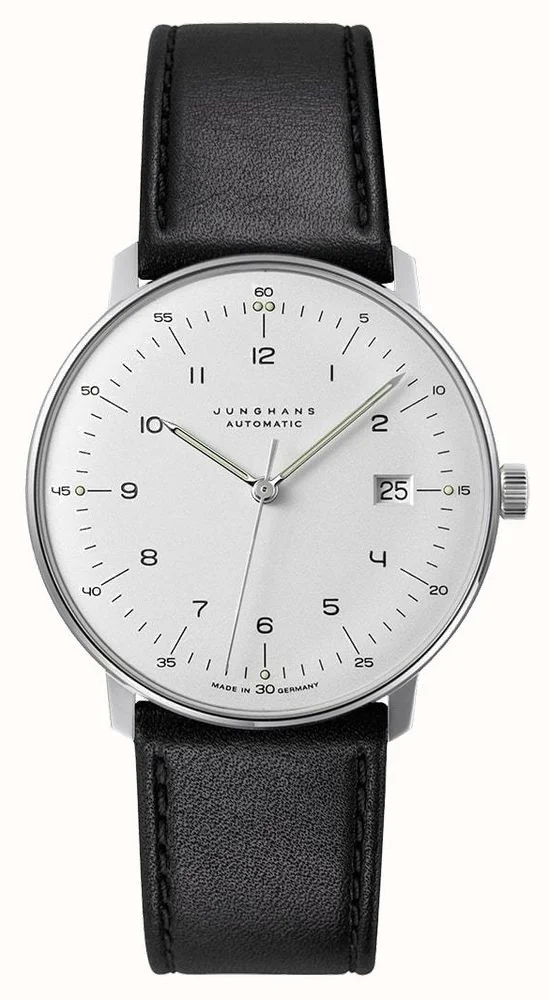
Line History
The collection is born from the encounter between Junghans and Max Bill (1908-1994), a Swiss architect, artist and designer trained at the Bauhaus in Dessau and later a co-founder and lecturer at the Ulm School of Design (Hochschule für Gestaltung). The collaboration begins in the mid-1950s with the design of kitchen and table clocks — including a celebrated kitchen clock now held in the permanent collection of New York's MoMA — and culminates in 1961 with the first wristwatch signed by Max Bill for Junghans.
The design applies to watchmaking the principles learned at the Bauhaus and taught at Ulm: elimination of every non-functional element, a white dial readable at a glance, thin baton indices, essential hands and, in the original version, no date window or numerals to disturb the surface. The result is an object that prioritizes clarity of reading above any decorative intent, in perfect keeping with the "form follows function" philosophy dear to the movement.
Discontinued and then reintroduced by Junghans in the early 2000s, the Max Bill line is today the brand's most identifiable product and has been produced in numerous case, movement and dial variants — from the manual three-hand version to the chronograph, up to a solar-powered radio-controlled edition — while always keeping the same graphic language designed over six decades ago.
Technical Specifications
Main Executions
Max Bill was not a trained watchmaker but a multi-talented architect and artist, awarded the "Prix" at the 1936 Milan Triennale: his first project for Junghans, in the mid-1950s, was a drop-shaped kitchen clock, now held in the permanent collection of New York's MoMA — only a few years later, in 1961, would the first wristwatch arrive.