

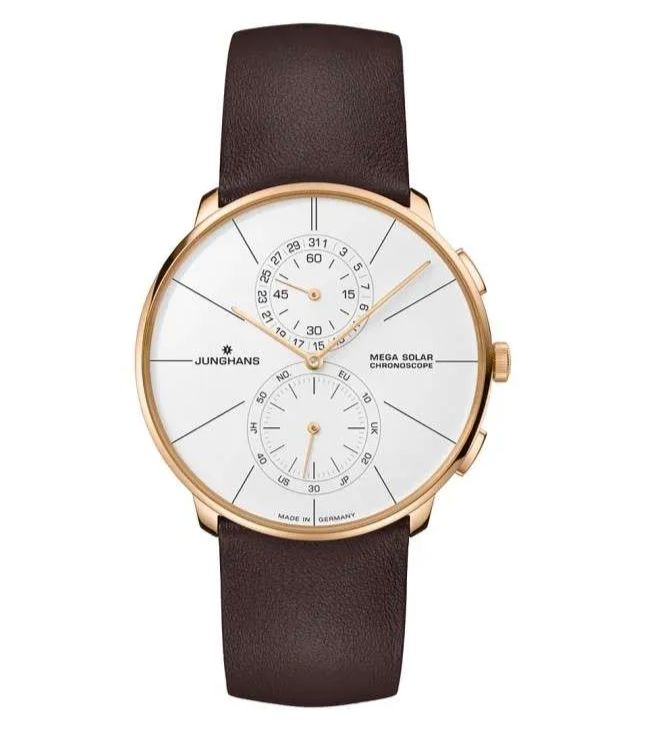
Line History
The name "Meister" (German for "master") is introduced in 1936 as a quality seal that Junghans reserves for its highest-tier wristwatches, at a time when the company is already one of the largest watchmaking concerns in the world and is consolidating its reputation in precision chronometer production as well. The line goes through its period of greatest prominence between the 1930s and the 1960s, becoming the reference point for the most carefully made mechanical watches in the Junghans catalogue.
Unlike the Max Bill line, born from a single design project that has remained substantially unchanged, Meister has from the outset been a broader and more varied collection, able to absorb different languages over time: from classically laid-out three-hand models to chronographs, up to executions with aeronautical or automotive influences. The common thread remains a sober elegance, consistent with German taste for readability and restraint, never excessive in materials or decoration.
In its contemporary form, relaunched starting in the 2000s, Meister sits in the Junghans catalogue alongside Max Bill and Form as one of the brand's pillar collections: today it represents the most classic and "wearable" soul of the range, set against the almost-radical rigor of Bauhaus design and the more contemporary stamp of the Form line.
Technical Specifications
Main Executions
The term "Meister" was already in use in Germany as a mark of craftsman's guarantee well before being adopted by Junghans: by applying it to its wristwatches in 1936, the company meant to signal to the public that those models were the qualitative peak of a production that, at the time, already counted millions of pieces a year.