

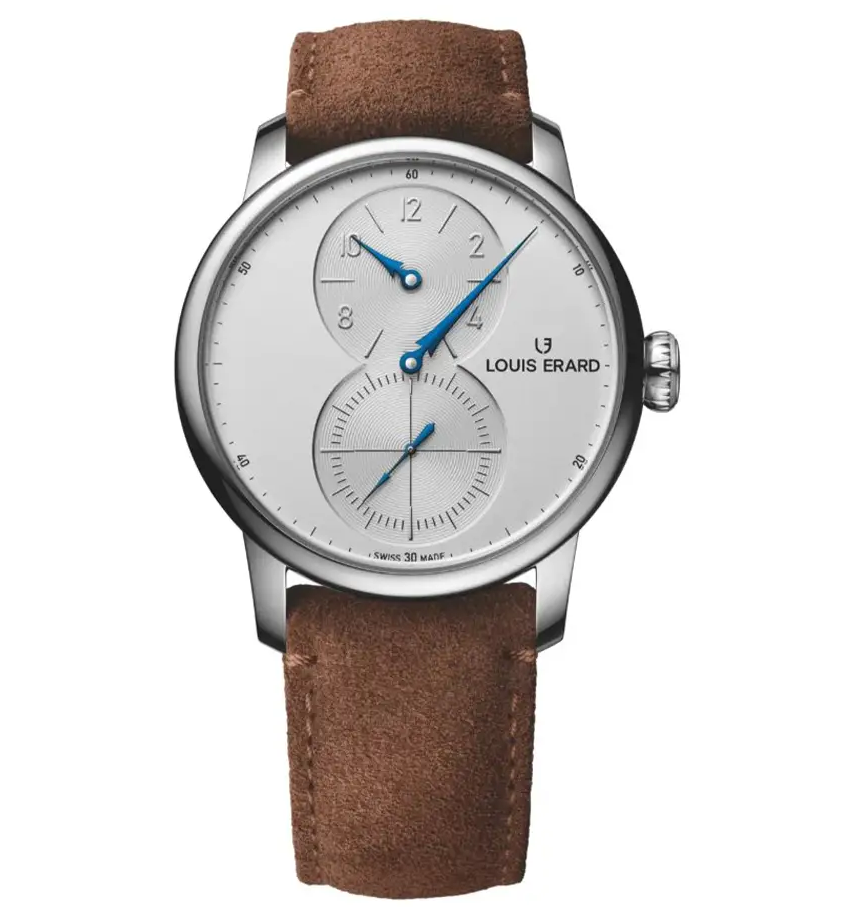
Le Régulateur
Collection History
The regulator is a dial layout whose roots go back to the eighteenth century, when watchmakers used highly precise clocks to regulate the other instruments in their workshop (hence the name) and in railway stations to ensure uniform timekeeping. Its distinguishing feature is the separation of the three counters: the minute hand occupies the center of the dial, while hours and seconds are relegated to small separate counters, usually at 12 and 6 o'clock, instead of being stacked as in a traditional watch.
Louis Erard rediscovered this layout as early as the 1980s, when it modified the Peseux 7001 caliber by adding a power-reserve indication and a regulator display. The idea was revived and relaunched in 2011, with the debut of Le Régulateur as a standalone collection, based on modified Sellita calibers: a way to offer a wider audience a complication historically associated with high watchmaking, without the costs of an entirely in-house manufacture.
From being its own collection, Le Régulateur has over the years become the common ground on which almost all of Louis Erard's collaborations with independent watchmakers and designers take shape: the same dial architecture — free of stacked central hands — offers outside collaborators an ideal surface on which to apply their own aesthetic, as described in the page dedicated to the collaborations with Alain Silberstein and the other independent names involved by the brand.
Technical Specifications
Main Executions
In historical regulators the separation of the counters was not an aesthetic choice but a technical one: it prevented the gear trains of the different hands from interfering with each other, ensuring a more precise time reading for those who had to use the clock as an absolute reference. Louis Erard has turned this eighteenth-century technical detail into a stylistic trait recognizable at a glance.