

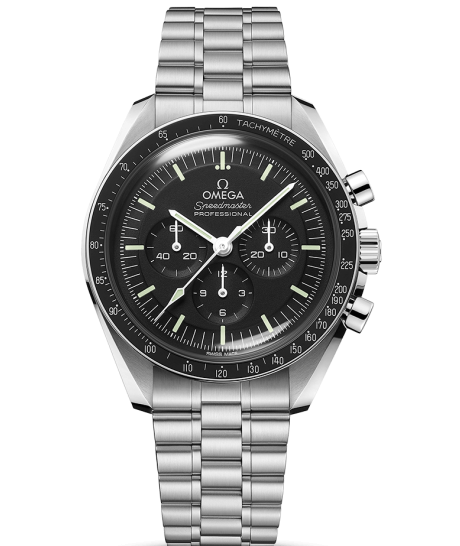
Line History
The Speedmaster debuts in 1957 as a chronograph designed for race car drivers and engineers, as part of the same launch that also brings to market the Seamaster 300 and the Railmaster: a trio of professional instruments that, decades later, enthusiasts have collectively nicknamed the "Trilogy." The first reference, the CK2915, introduces two distinctive traits that will accompany the line throughout its history: the steel tachymeter bezel (instead of the more common rotating ring) and the "spectacles" layout of the chronograph's three sub-dials, designed for quick reading of elapsed times during a race.
The turning point comes in 1965, when NASA subjects several commercially available chronographs to a series of brutal tests — thermal shocks, vacuum, vibration, humidity, acceleration — to select an instrument to supply to the crews of the Mercury, Gemini and Apollo programs. On March 1, 1965, the Speedmaster, in the version then on the market, turns out to be the only one to pass the entire battery of tests and is officially qualified for all crewed missions, including extravehicular activities in open space. From that moment the watch accompanies American astronauts through all the major space programs, from Gemini to the Apollo missions.
The moment that definitively cements the line's legacy comes on July 21, 1969: during the Apollo 11 mission, the Speedmaster Professional on the crew's wrist becomes the first watch worn on the lunar surface, earning from then on the informal nickname "Moonwatch." Another episode, less well known but equally celebrated by enthusiasts, concerns the Apollo 13 mission of 1970: after an oxygen tank explosion, the crew uses their own Speedmaster to manually time a critical engine burn needed for the return to Earth in the absence of reliable onboard instrumentation — a contribution that earns Omega, in 1970, the Silver Snoopy Award from NASA.
In the following decades the line has expanded enormously without ever abandoning its reference model, today marketed as the "Speedmaster Moonwatch Professional": alongside the original manual-wind caliber (the 321, later the 1861 and, from 2019, the 3861 with Co-Axial escapement and Master Chronometer certification), automatic versions, split-seconds chronographs, motorsport editions like the Speedmaster Racing, and commemorative series for space missions have all been born, while the historic model remains the only wristwatch still qualified by NASA for extravehicular activity.
Technical Specifications
Main Executions
The first Speedmaster to go into space was not a NASA choice but a personal initiative: in 1962 astronaut Wally Schirra bought a Speedmaster out of his own pocket at a store and carried it with him aboard the Mercury capsule during the Sigma 7 mission, three years before the watch underwent the official qualification tests of 1965.