

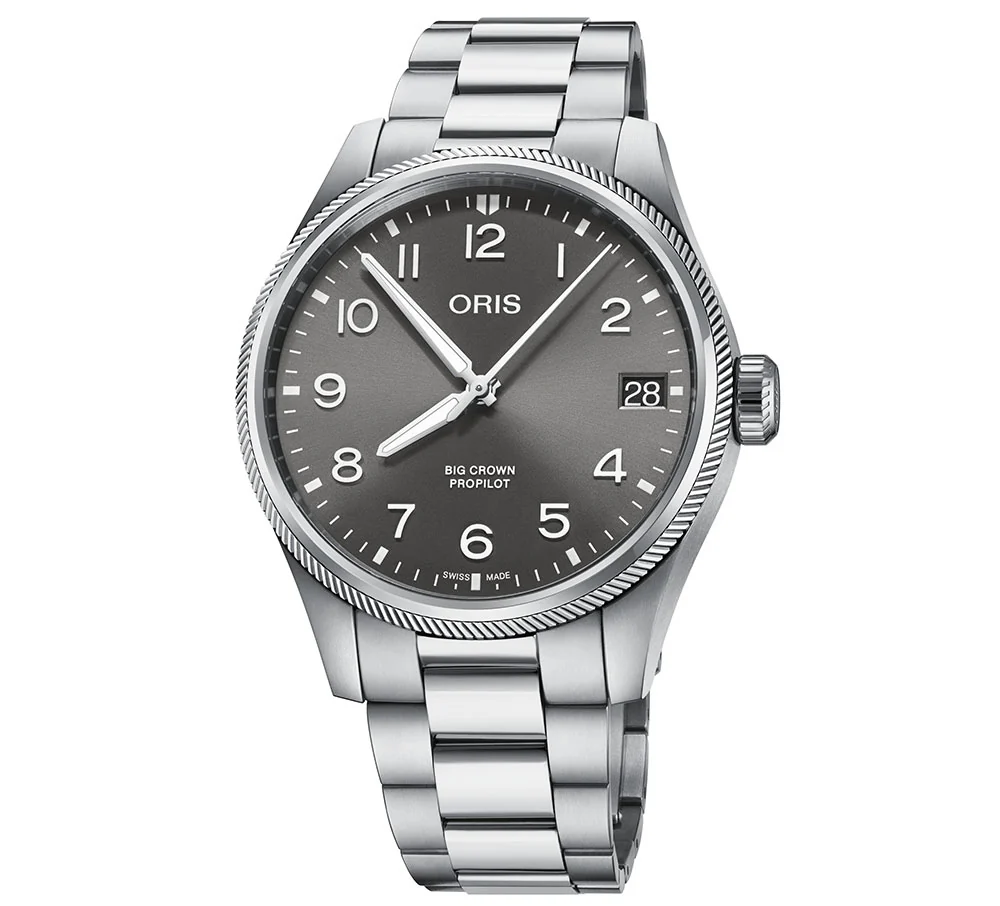
Big Crown ProPilot
Line History
Oris's bond with aviation is among the oldest and most continuous in all of Swiss watchmaking: a pocket watch for aviators already appears in 1911, followed in 1917 by one of the first wristwatches designed specifically for pilots. The leap in quality comes, however, in 1938, when the brand presents the Big Crown: the distinctive trait is the deliberately oversized crown, designed to be operated easily even while wearing flight gloves, paired with a pointer-date calendar readable at a glance in low-visibility conditions — a functional, not decorative, design that remains the line's hallmark to this day.
In the following decades the Big Crown family expanded into several sub-lines dedicated to the world of flight, culminating in the ProPilot designation, which today identifies the tier most oriented toward cockpit instrumentation: highly legible dials, GMT indications for pilots crossing multiple time zones, and sturdy steel or titanium cases designed for everyday as well as professional use. An important turning point comes from 2014, when Oris introduces its own family of manual-winding manufacture calibers (110-115), capable of a power reserve of up to 10 days thanks to a redesigned mainspring barrel — a feature few other brands in the same price range can offer.
The most recent ProPilot range has continued in the direction of genuine instrumentation: the GMT Small Seconds adds a second time zone to the classic reading, while the ProPilot Altimeter "Mission Control," presented in 2023, integrates a mechanical altimeter functioning up to 15,000 meters, measured via an aneroid capsule connected to an indicator on the dial — a further demonstration of the line's instrumental vocation, closer to flight instrumentation than to purely aesthetic watchmaking.
Technical Specifications
Main Executions
The pointer-date calendar introduced in 1938 on the first Big Crown — a central hand indicating the date on a scale printed along the edge of the dial, instead of the usual date window — was born precisely to be read at a glance by pilots in the cockpit, without drawing their attention too far from the flight controls.