
Perrelet
Brand History
Perrelet bears the name of Abraham-Louis Perrelet, a Swiss watchmaker born in 1728 in Le Locle and active as an independent master craftsman in eighteenth-century Neuchâtel. Around 1777 he developed an automatic winding mechanism based on an oscillating weight set in motion by the wearer's steps: the Geneva Society of Arts verified at the time that about fifteen minutes of walking were enough to wind the watch sufficiently for eight days of running. For this reason Perrelet is widely considered the inventor of the automatic rotor mechanism, even though it was Abraham-Louis Breguet who, a few years later, further refined its operation.
The contemporary watchmaking brand that bears this name was born from a relaunch as a wristwatch manufacture around the mid-1990s, with the explicit intent of paying homage to the eighteenth-century founder's legacy. In 1995 Perrelet presented its own "Double Rotor", developed with independent master watchmaker Paul Gerber (a member of the AHCI): a second rotor, visible on the dial, that overlaps the one that actually drives the movement underneath, making the principle invented by Abraham-Louis Perrelet two centuries earlier perceptible at a glance. Since 2004 the brand has been part of Grupo Festina, led by Miguel Rodriguez, with production headquarters in Bienne, in the heart of Swiss watchmaking.
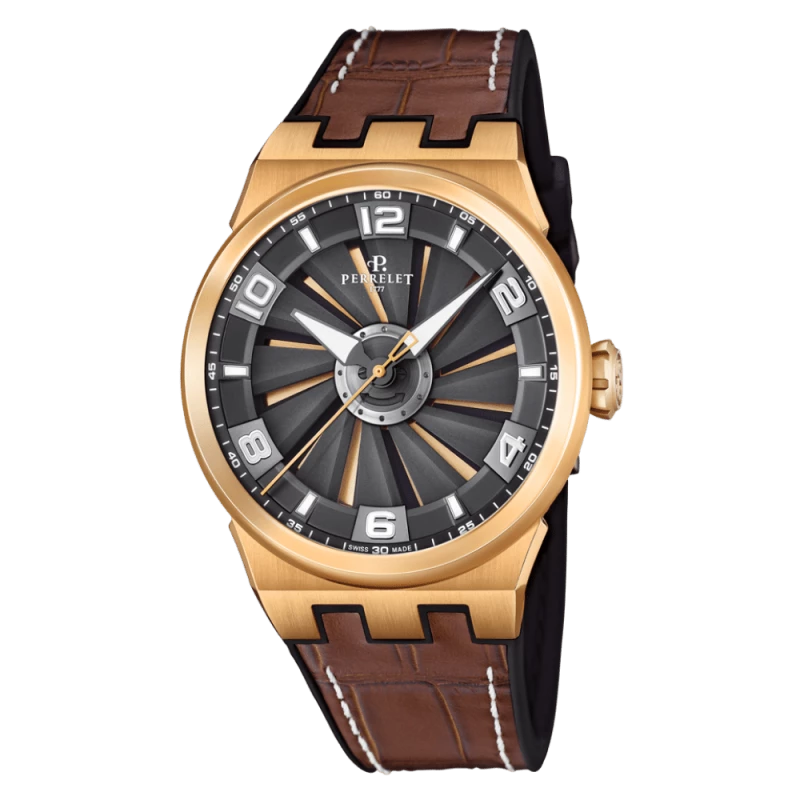
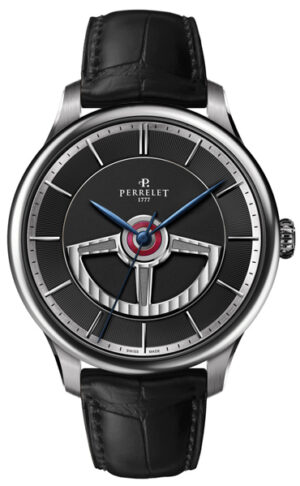
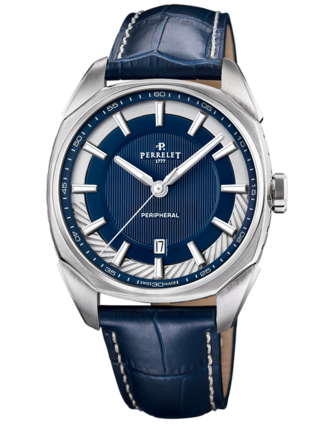
Over time, very different variations have emerged from the Double Rotor architecture: from the spectacular Turbine, which in 2009 transforms the second rotor into a genuine jet-engine turbine blade, to collections with a more classic approach such as First Class, through to more recent and technical interpretations such as LAB Peripheral, with a peripheral rotor visible along the edge of the dial. A thread that links every collection in the current catalogue to Abraham-Louis Perrelet's own inventive gesture.