

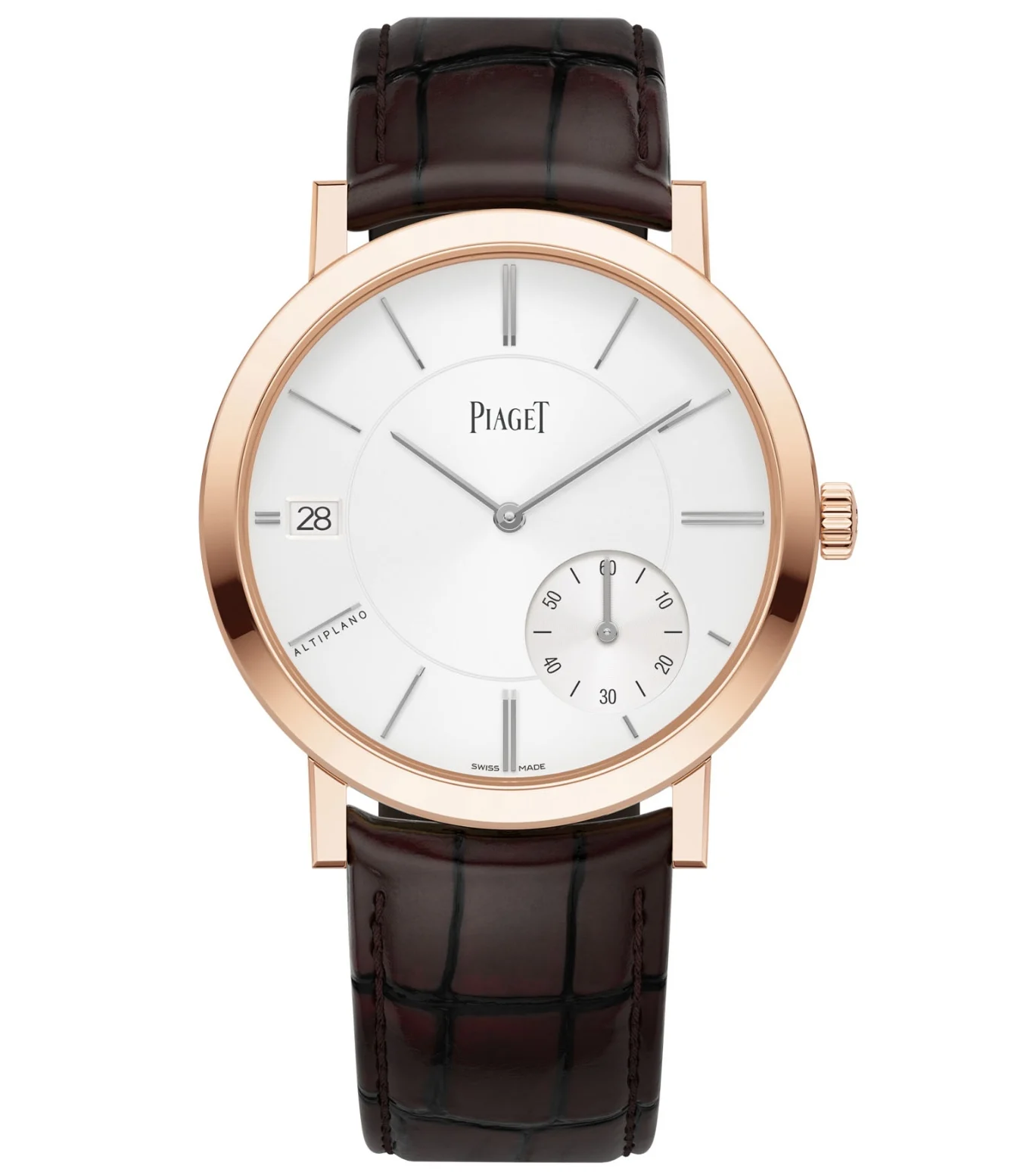
Altiplano
Line History
Although the Altiplano name officially appears only in 1998, its roots go back much further, to the very heart of Piaget's technical vocation. As early as 1957 the La Côte-aux-Fées manufacture presents the caliber 9P, a manual-winding mechanical movement just 2 mm thick: one of the most radical achievements ever reached in the miniaturization of a watch movement. An internal brand advertisement dating back to 1948 shows, moreover, that the pursuit of thinness was already an obsession of the house well before the official presentation of the 9P, with announcements claiming "the only ultra-thin automatic watch in the world" at 2.3 mm thick.
In 1960 comes the caliber 12P, an automatic evolution of the 9P: thanks to a peripheral heavy-metal micro-rotor integrated into the plane of the components — instead of overlapping them, as in traditional rotors — the 12P manages to maintain a total thickness of just 2.3 mm, becoming the thinnest automatic movement in the world for its time. These two calibers, the 9P and the 12P, remain to this day the technical forebears of the entire Altiplano line and the foundation of the manufacture's ultra-thin identity.
When in 1998 Piaget formally christens the collection with the name Altiplano, it does so to bring together, under a single coherent line, decades of extremely thin dress watches, characterized by clean dials, understated cases and a minimalist aesthetic language that lets the thinness of the movement alone speak. The line quickly becomes, in the maison's own words, "the manufacture's creative pillar", synonymous with discretion, refinement and geometric rigor, in sharp contrast to the chromatic and jewel-like exuberance of other Piaget collections.
The record-setting journey does not stop in the 1960s: in 2014 the manufacture presents the caliber 900P, which becomes the thinnest manual-winding mechanical movement in the world, integrated directly into the Altiplano case for a result of just 3.65 mm total thickness for the entire watch. A decade later, in 2024, Piaget takes this pursuit to its extreme consequences with the Altiplano Ultimate Concept, capable of reaching a total thickness — case and movement combined — of just 2 millimeters, even including tourbillon versions: a result that, at the time of its presentation, is unmatched in the entire mechanical watch industry.
Line Characteristics
Main Executions
In the Altiplano Ultimate Concept, Piaget eliminates the traditional separation between case and movement: the watch's case back is also the caliber's main plate, and even the screws and hands have been redesigned from scratch to shave off fractions of a millimeter. A level of integration that makes each piece, more than a watch in the classic sense, an engineering exercise pushed to the limits of materials physics.