

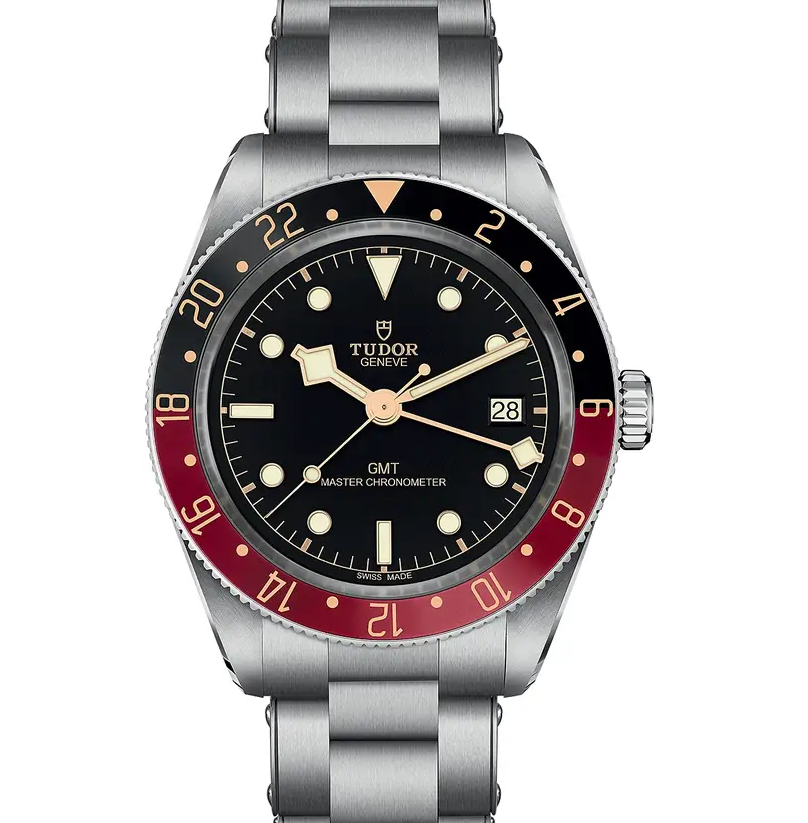
Black Bay
History of the line
The Black Bay debuted at Baselworld in 2012 with reference 79220R, which went down in history as the "Heritage Black Bay" in its burgundy-bezel version. It is not a reissue of a single vintage watch, but a deliberate synthesis of elements taken from three distinct historic references of the Oyster Prince Submariner divers: the case shape of the 7922 (the first Tudor Submariner, 1954), the large crown of the "Big Crown" 7924 (1958) and the "snowflake" hands of the 7016 (1969). A 41 mm case, gilt dial, no date window — a deliberately "pure" design choice, going against the grain of most contemporary divers.
The first developments came quickly: the blue 79220B variant in 2014, and in 2015 a rare version with a black bezel and red triangle (79220N), produced for only about six months. 2016 was the year of the industrial breakthrough, with the switch to the in-house MT5602 calibre (70-hour power reserve) and the arrival of a 43 mm bronze case (79250BM) with a brown dial that develops a patina with use. Then came the Black Bay Steel (79730, 2017), with a steel bezel and date, and in 2018 the Black Bay GMT "Pepsi" (79830RB), the first Tudor with a GMT function.
Also in 2018 came the Black Bay Fifty-Eight (BB58), with a 39 mm case truer to the proportions of the 1958 Oyster Prince Submariner and the MT5402 movement: it quickly became one of the most popular models in the range for those looking for a more compact size. The following years brought ceramic versions certified as Master Chronometers (2021), precious-metal editions of the BB58 (bronze, 925 silver, 18-carat gold) and the 37 mm Black Bay 54 (2023), a direct tribute to the very first 1954 Oyster Prince Submariner. Today the Black Bay is the largest and most defining family in the Tudor catalogue.
Technical specifications
Notable references
The 2012 Black Bay does not reproduce a single period watch, but freely mixes elements from three different references: precisely for this reason the designers had complete freedom in choosing colours, such as the burgundy of the first bezel, which actually has no direct precedent on the Tudor divers of the 1950s and '60s.