

History of the line
In 1941 UROFA, the movement manufacturer linked to Tutima, developed calibre 59: according to the brand's historical account, it was the first two-pusher flyback chronograph made in Germany. Fitted in a nickel-plated brass case with screw-down caseback and a fluted rotating bezel with telemeter scale, it powered the pilot's chronographs issued to the Luftwaffe: around 30,000 were produced between 1941 and 1945, before the bombing of Glashütte and the subsequent Soviet dismantling of the machinery meant that even the calibre's original drawings were lost.
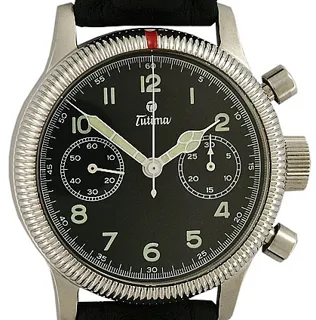
The Flieger line was born in the early 1990s as a modern reissue of that watch: reference 783-01, with a 38.5 mm case, faithfully reproduces the layout of the black dial with luminous Arabic numerals, the skeletonised hands and — above all — the fluted bezel with telemeter scale and red index at 12 o'clock of the 1941 original, fitted with a hand-wound movement derived from the Valjoux 7760. The model remained in production for more than twenty years, becoming the stylistic reference point for the entire collection.
Several versions have been built on this base over time, including 18k yellow gold versions made to order, while today's Flieger includes variants such as the Flieger Legacy, Automatic and T5, which update case and movement while remaining faithful to the 1941 dial and bezel design. In the current catalogue the line sits alongside the larger Grand Flieger and the M2, which instead descends from the 1984 NATO military chronograph.
Technical specifications
Main versions
"Flieger" simply means "aviator" in German: the term is now used throughout watchmaking for pilot's watches inspired by German military designs in general, but at Tutima it is also the proper name of this specific collection, the most direct heir of the 1941 chronograph.