

Grand Flieger
History of the line
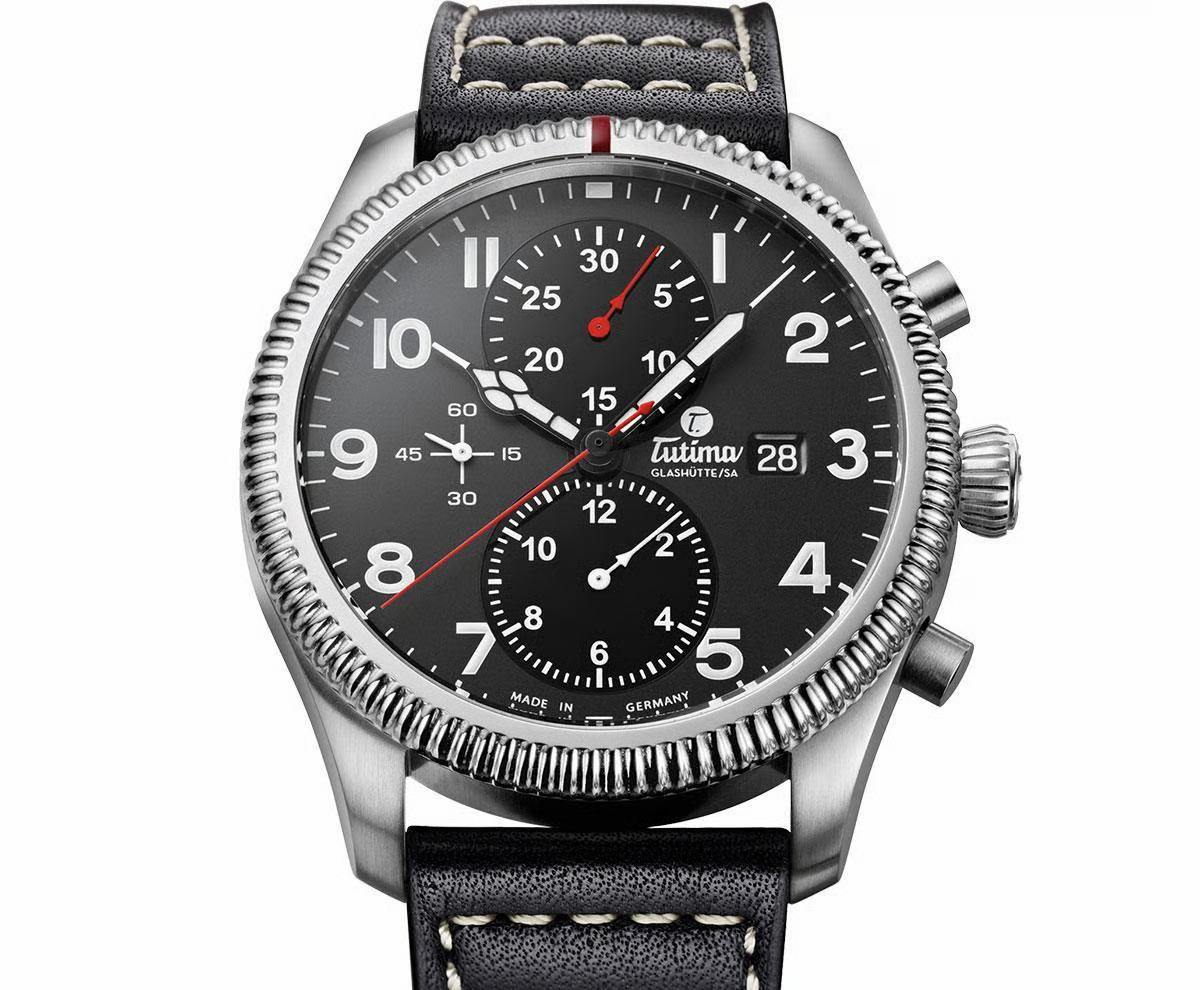
The Grand Flieger was born in 2013 with the Classic Chronograph, presented by Tutima as a larger, more "manufacture" reinterpretation of the 1941 pilot's chronograph than the Flieger line already in the catalogue: the same rotating bezel with red reference index recalling the original, but in a 43 mm steel case 16 mm thick, aimed at collectors as well as aviation history enthusiasts.
The movement is the Tutima calibre 320, a modified automatic Valjoux 7750 certified as a chronometer under the German DIN 8319 standard — the local equivalent of the better-known Swiss COSC — underlining the brand's intention to present the Grand Flieger as a fully fledged German manufacture product. The matt black dial with 30-minute counter at 12 o'clock, 12-hour counter at 6, running seconds at 9 and date at 3 is protected by a domed sapphire crystal with anti-reflective coating, while the black aviator leather strap with white stitching completes a deliberately flight-instrument look.
From this first model the Grand Flieger line has expanded with further versions, including the Airport variant, keeping the larger case and manufacture positioning that set it apart both from the more compact Flieger and from the M2, the latter being a direct heir of the NATO military chronograph rather than of the 1941 design language alone.
Technical specifications
Main versions
The DIN 8319 marking, engraved on the caseback of certified models, is the German chronometer standard: a detail the Grand Flieger shares with few other Glashütte manufactures, and which the brand promotes as a home-grown alternative to Swiss COSC certification.