

History of the line
In 1984, using the Swiss Lemania 5100 automatic calibre as a base, Tutima developed the Military Chronograph reference 798: a 43 mm steel case with column-wheel chronograph, central minute counter, running seconds, day of the week in German and — a deliberate choice — no tachymeter scale, in favour of a dial as legible as possible in the cockpit. The sapphire crystal is secured to withstand low pressure up to an altitude of 50,000 feet.
The watch was adopted as standard equipment for Luftwaffe pilots and, more broadly, by NATO, which assigned it its own stock number (6645-12-194-8642): a requirement that led Tutima to certify its water resistance, initially 100 metres and later increased to 200 metres, and over time also to produce a titanium version, lighter than the steel one. The Military Chronograph 798 stayed in service with German pilots for decades, earning a reputation as one of the last true military pilot's watches designed before quartz arrived in the cockpit.
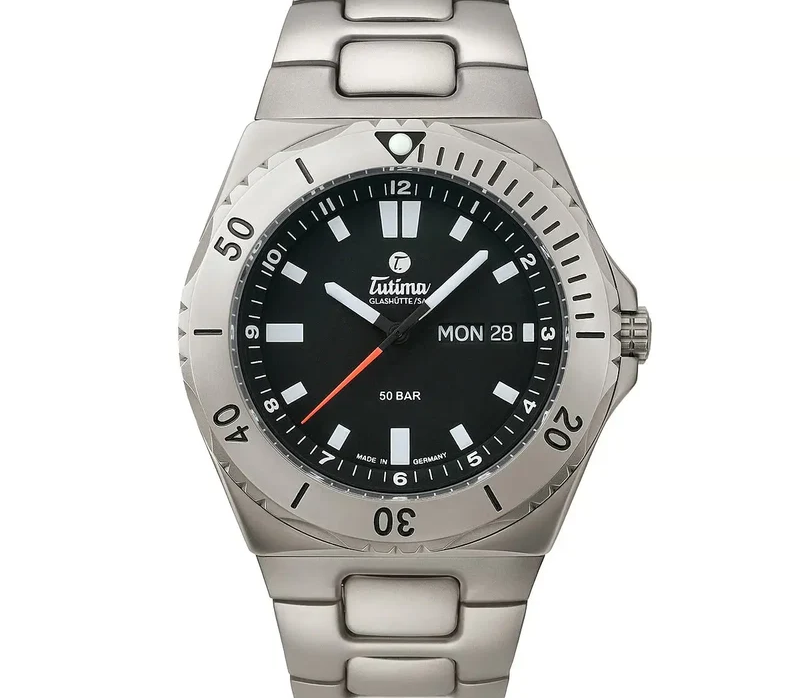
When the Lemania 5100 went out of production, Tutima developed its own automatic calibre, the 521, protected by a mu-metal cage against magnetic fields, to continue the NATO chronograph tradition in a case made entirely of pure titanium: thus the current M2 line was born, which has since expanded with variants designed for settings other than pure aviation, such as the Pioneer, Seven Seas, Coastline and Mara Safari.
Technical specifications
Main versions
The look of the Military Chronograph 798, with its spare dial and no tachymeter scale, is sometimes traced back to the influence of the Porsche Design chronograph made by Orfina in the 1970s: a stylistic kinship between two of the most recognisable pilot's watches made in Germany.