

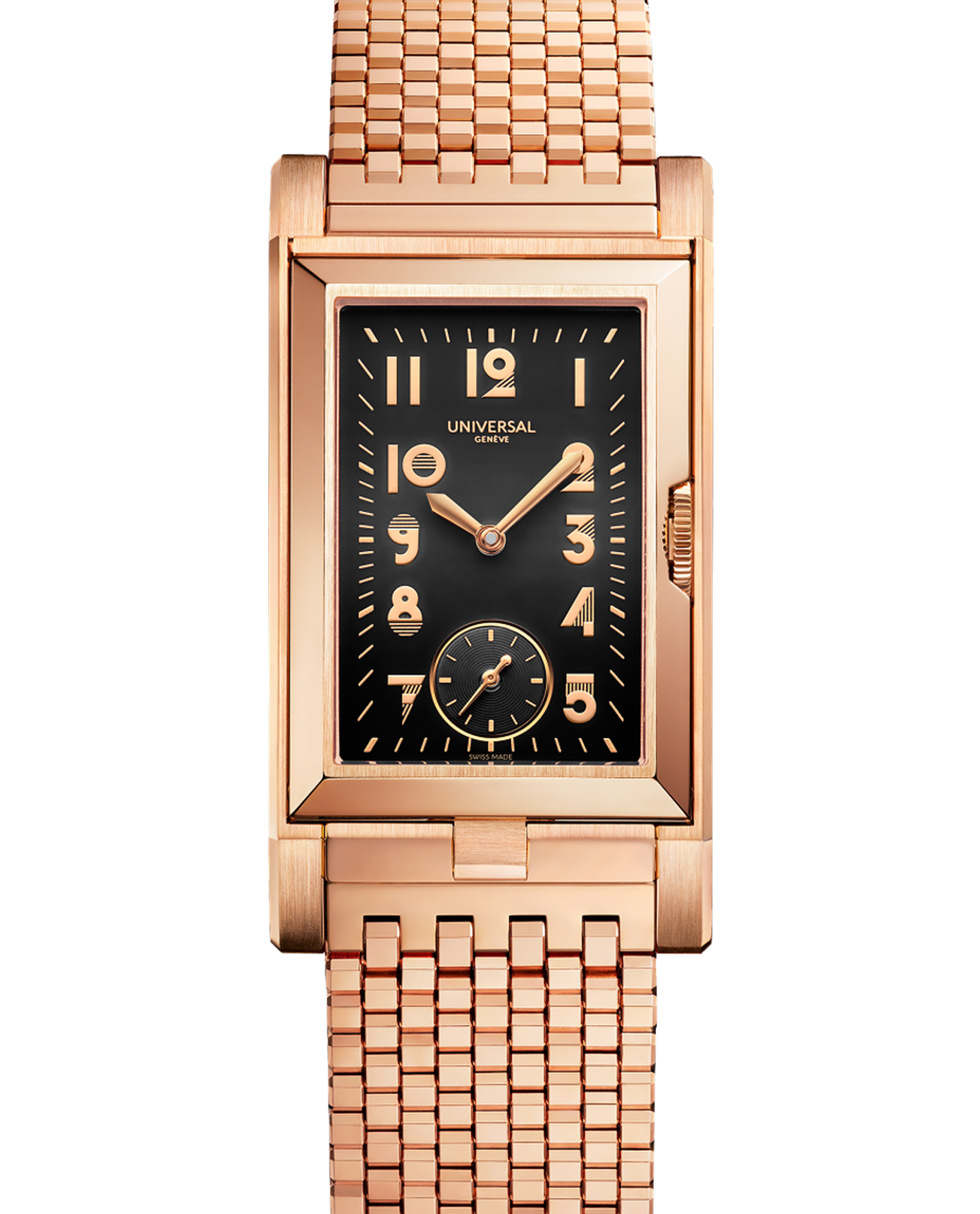
Cabriolet
History of the line
The Cabriolet line was born in 1933 under the name Ideo, a rectangular-cased wristwatch with a flipping mechanism that allows the dial to be turned inwards to protect it from knocks and scratches: an ingenious solution typical of 1930s travel and sports watches, now more generally known as a "cabriolet" or reversible case.
The model's design fully reflects the Art Deco language of the time, with stylised numerals (in the "Bifur" style, inspired by the typefaces designed by A. M. Cassandre) and architectural geometries that also recall the work of artists such as Tamara de Lempicka. In 1994, for the brand's centenary, Universal Genève made a special series called the Golden Janus, limited to just 10 pieces and now sought after by collectors.
In the 2026 relaunch the Cabriolet returns with a new hand-wound calibre (UG-111) housed in a 45 × 24.2 mm reversible case, offered in a Prêt-à-Porter line with lacquered dials in several colours and in a Capsule edition with hand-painted dials explicitly inspired by the work of Tamara de Lempicka, in a limited run.
Technical specifications
Main versions
The name of the centenary edition, Golden Janus, refers to Janus, the two-faced Roman god: a particularly fitting reference for a watch whose case can literally "turn" on itself to show two different faces.