
Universal Genève
Brand history
Universal Genève was born in 1894 in Le Locle, in the Swiss Jura Arc, founded by Numa-Émile Descombes and Ulysse-Georges Perret under the name Universal Watch. In 1919 the headquarters moved to Geneva and the brand took the name by which it is known today, building over the following decades a solid reputation for high-quality chronographs and complications.
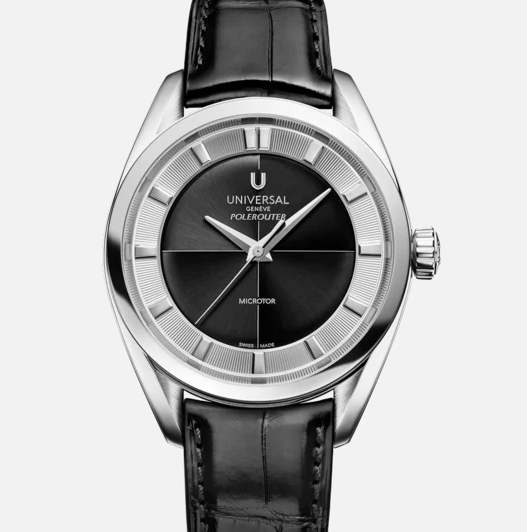
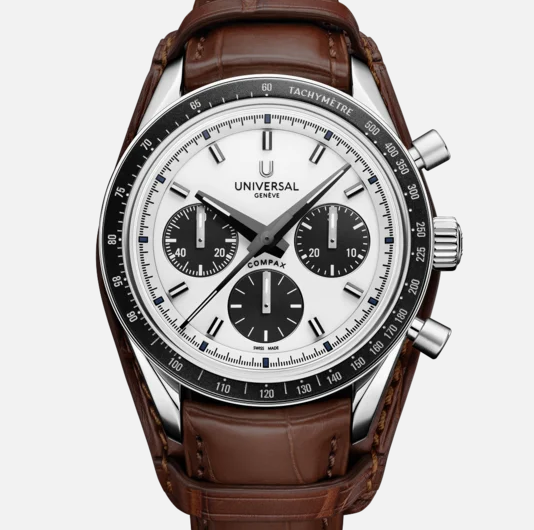
The brand's golden age was concentrated in the mid-20th century: in 1936 came the Compax, the house's first three-counter chronograph, which in the following decades became one of the brand's most celebrated chronograph families (including the variant known as "Nina Rindt", after the wife of Formula 1 champion Jochen Rindt, linked to the famous 1960s "panda" dial). In 1954 a 23-year-old Gérald Genta designed the Polerouter to celebrate the first polar route of Scandinavian Airlines System between Los Angeles and Copenhagen: it would become the manufacture's most defining model. Technically, Universal Genève also stood out as a pioneer of micro-rotor automatic movements, introduced with calibre 215 in 1958 and refined in calibre 1-66 in the 1960s.
The quartz crisis of the 1970s and '80s hit the brand hard, and in 1989 it was acquired by the Hong Kong group Stelux Holdings: decades of intermittent production and a gradual drift away from haute horlogerie followed, leading to a long dormant phase that made Universal Genève a cult brand among vintage collectors. On 12 December 2023 the brand's intellectual property was acquired by Partners Group, the same investor that controls the Breitling group; the relaunch, publicly announced in November 2024 under Breitling CEO Georges Kern, took shape during 2026 with new in-house calibres and several collections, including the three historic lines described here. As this is a very recent and still ongoing relaunch, some details about the range, availability and final positioning may still change in the coming years.