

Compax
History of the line
The Compax was born in 1936 as Universal Genève's first three-counter chronograph, with registers for running seconds, 30 minutes and 12 hours: a layout that would become a standard of 20th-century chronograph watchmaking. In the following years the "Compax" name would accompany several variants of the family, from the Aero-Compax designed for aviation to the Tri-Compax with full calendar.
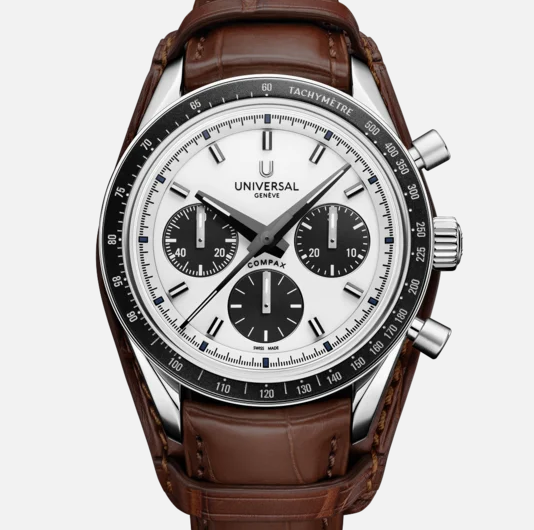
The line's moment of greatest fame came in the 1960s, when the Compax with a white dial and three black counters — later nicknamed "Nina Rindt" by collectors after the wife of Formula 1 driver Jochen Rindt, often photographed wearing it — became one of the most sought-after and imitated vintage chronographs, contributing significantly to the later success of the so-called "panda dial" across sports watchmaking.
In Universal Genève's 2026 relaunch the Compax returns as one of the pillars of the new range, with an in-house micro-rotor, column-wheel calibre (UG-200) — the first micro-rotor chronograph in the brand's history — offered in a 39.5 mm case and in dial variants that explicitly recall the historic "panda" and "reverse panda".
Technical specifications
Main versions
The nickname "Nina Rindt", which collectors still use today for the most famous variant of the vintage Compax, is not an official Universal Genève catalogue name: it comes from period photographs in which Nina Rindt, wife of Formula 1 champion Jochen Rindt, is repeatedly seen wearing the watch at the trackside.