

History of the line
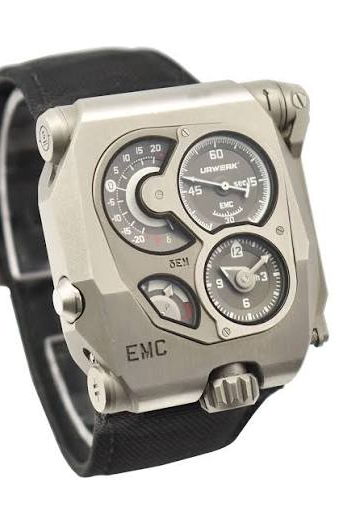
The EMC line — short for "Electro Mechanical Control" — debuted at Baselworld 2013 as the series that gives its name to the UR-Chronometry family, distinct from the satellite complications of the UR-Satellite series. Felix Baumgartner described it as "the first high-end mechanical movement with a brain": a watch that is entirely mechanical in its regulating organs, but equipped with an integrated electronic system able to measure the accuracy of its own balance.
The mechanism works like this: an optical sensor observes the oscillations of the balance, made of ARCAP (a non-magnetic, corrosion-resistant alloy already used by Urwerk), and compares them with a 16-million-hertz reference oscillator. To start the measurement, the wearer turns a crank on the caseback connected to a small Maxon generator, which charges a supercapacitor; then, by pressing a pusher at 8 o'clock for about three seconds, a hidden hand shows on a red sector of the dial how far the movement is running fast or slow, with a stated precision better than 10 microseconds.
The hand-wound UR-EMC calibre has two barrels mounted in series for an 80-hour power reserve. A second chapter of the line arrived in 2016 with the EMC Time Hunter, a redesigned version — with a see-through caseback over the electronic mechanism — that makes the accuracy-monitoring system introduced in 2013 even easier to read.
Technical specifications (EMC, 2013)
Key milestones of the line
To read its own accuracy, the EMC requires a small ritual: first the supercapacitor is charged by turning a crank on the caseback about fifteen times, then a pusher at 8 o'clock is held down for three seconds — only then does a dedicated hand reveal, on a red sector of the dial, how far the movement is running fast or slow compared with the internal electronic reference.