
Urwerk
Brand history
Urwerk was born from the meeting of two very different paths: that of Felix Baumgartner, a watchmaker born in Schaffhausen into a family of restorers and a graduate of the Solothurn watchmaking school, and that of Martin Frei, a graphic designer born in Winterthur and trained at the Hochschule für Gestaltung und Kunst in Lucerne. The two met at a student party in December 1995 and, together with co-founder Thomas Baumgartner, launched the project that officially became Urwerk in 1997. The name combines "Ur", from the ancient Mesopotamian city of Ur — one of the first places where humans measured time — and "Werk", German for "work" or "mechanism".
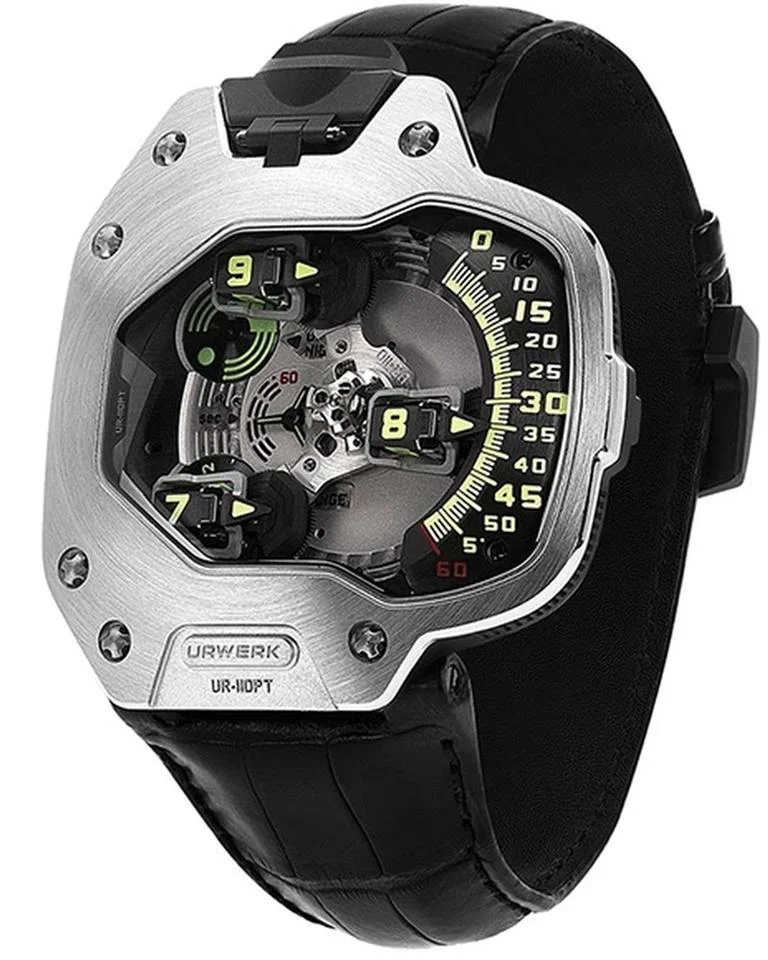
The debut came at Baselworld 1997 with the UR-101 and UR-102, which took up and mechanically reinterpreted wandering hours, a complication born in the 17th century for the Popes' pocket watches. After six years of development, 2003 brought the UR-103, which introduced the orbiting satellite display — three rotating arms carrying the hour numerals along a semicircular path above the minutes scale — and which remained the manufacture's most recognisable model for almost a decade. In 2005 Urwerk worked with Harry Winston on the Opus 5, while the following years brought innovations such as turbine winding (UR-202, 2008) and the large UR-1001 pocket watch with satellite calendar (2011).
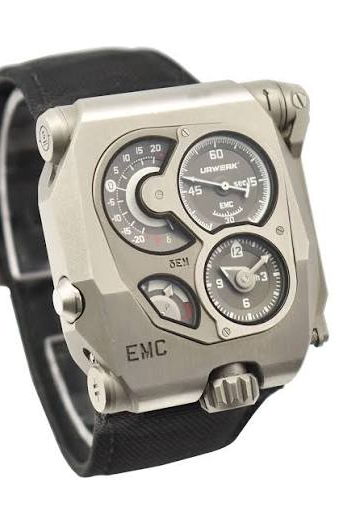
Today Urwerk remains a very small independent manufacture, based in Geneva, producing a limited number of numbered pieces each year across a few active collections — including the UR-Satellite series, devoted to orbital complications, and the UR-Chronometry series, devoted to electronic monitoring of accuracy. Felix Baumgartner continues to handle the watchmaking and technical side, Martin Frei the aesthetic and conceptual side.