

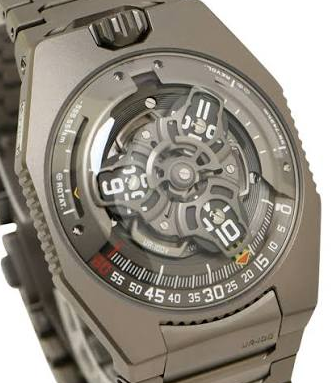
UR-100
History of the line
The UR-100 line was born in September 2019 with the UR-100 "SpaceTime", presented as the entry-level model in the Urwerk catalogue. Compared with the manufacture's more spectacular satellite complications, the SpaceTime uses the same satellite hours mechanism inherited from the 2003 UR-103, but puts it at the service of an idea that is more conceptual than technical: two minute hands, mounted on the hour satellites, show the distance travelled by the Earth in its rotation on its own axis (555 km every 20 minutes, measured at the equator) and in its orbit around the Sun (35,740 km over the same time span).
The brand itself described this dual indication as "a philosophical exercise more than a mechanical development", since both scales are read by the same satellite mechanism, simply graduated differently on the bridge. The case, in steel or PVD-treated titanium, has an elongated octagonal shape designed to be slimmer and easier to wear than the manufacture's historic models, while keeping intact the sculptural visual language signed by Martin Frei.
After the launch, the line expanded with the UR-100V family — which uses a new automatic calibre developed with Vaucher — in several versions, including Gunmetal and Ultraviolet variants and, in 2024, the LightSpeed, which replaces the Earth-rotation indication with the time taken by sunlight to reach the eight planets of the solar system.
Technical specifications (SpaceTime, 2019)
Key milestones of the line
The two distances shown by the SpaceTime — that of the Earth's rotation and that of its orbit around the Sun — are read on exactly the same satellite mechanism, simply graduated with two different scales: Urwerk chose to describe it as a conceptual game about the perception of time and motion, rather than as a new mechanical complication.