
Vianney Halter
Brand history
Vianney Halter was born in Besançon in 1963 and trained at the Paris School of Watchmaking, graduating in the early 1980s. He spent the following decade not designing his own watches, but restoring them: for about ten years he worked as a restorer of antique clocks and watches, an activity that brought him into close contact with the most complex mechanisms of past centuries' watchmaking and which, by his own admission, shaped his eye and his hand far more than any theoretical course.
In 1989 he moved to Switzerland and in 1991 joined THA Ébauches, the movement development workshop founded with François-Paul Journe and Denis Flageollet — two names who would themselves become leading figures in independent watchmaking. In those years Halter built complications to order for major maisons such as Audemars Piguet, Franck Muller, Jaquet Droz and Mauboussin, a top-level apprenticeship that preceded the launch of his own name by a few years. In 1994 he founded the Manufacture Janvier in Sainte-Croix, named in tribute to the 18th-century clockmaker and astronomer Antide Janvier.
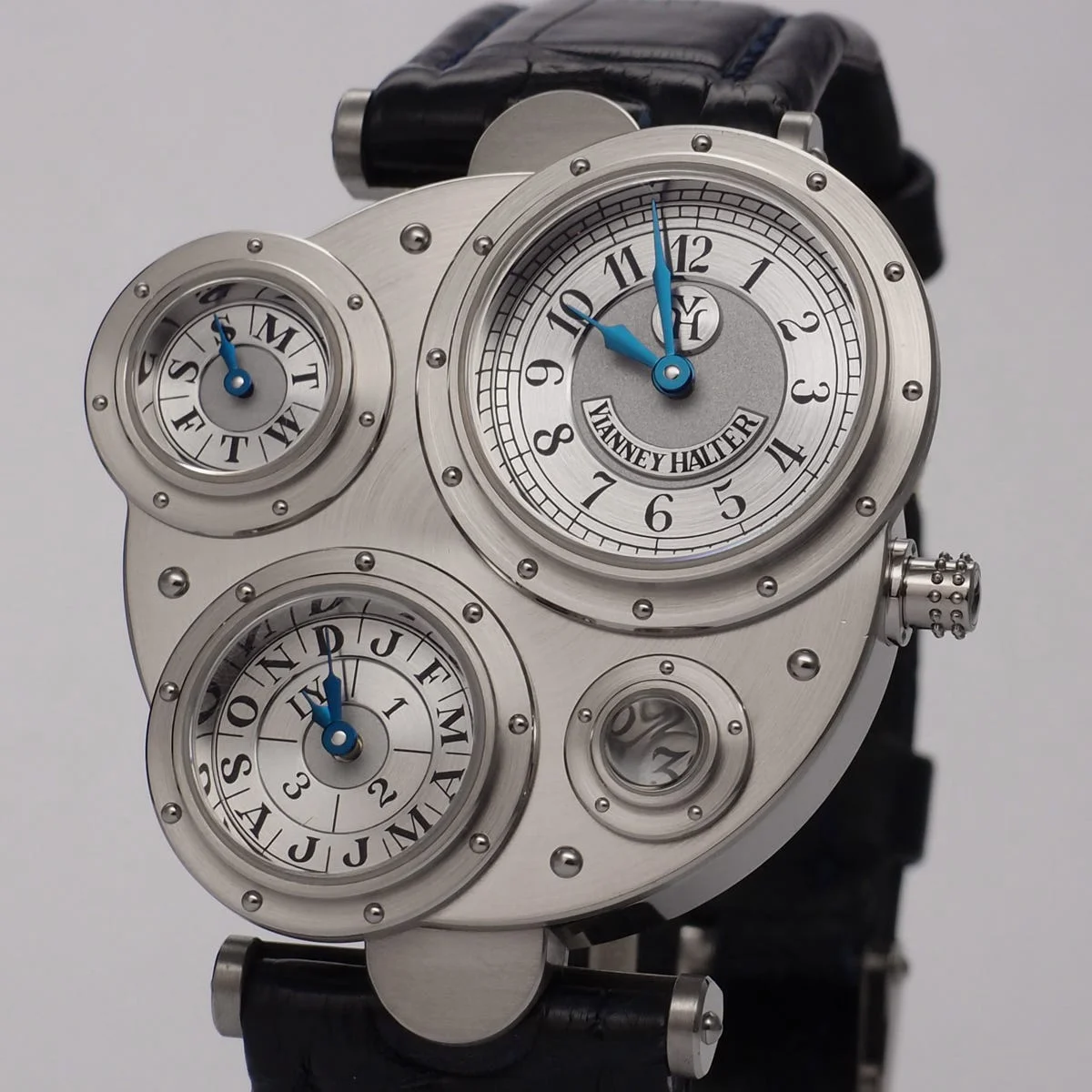
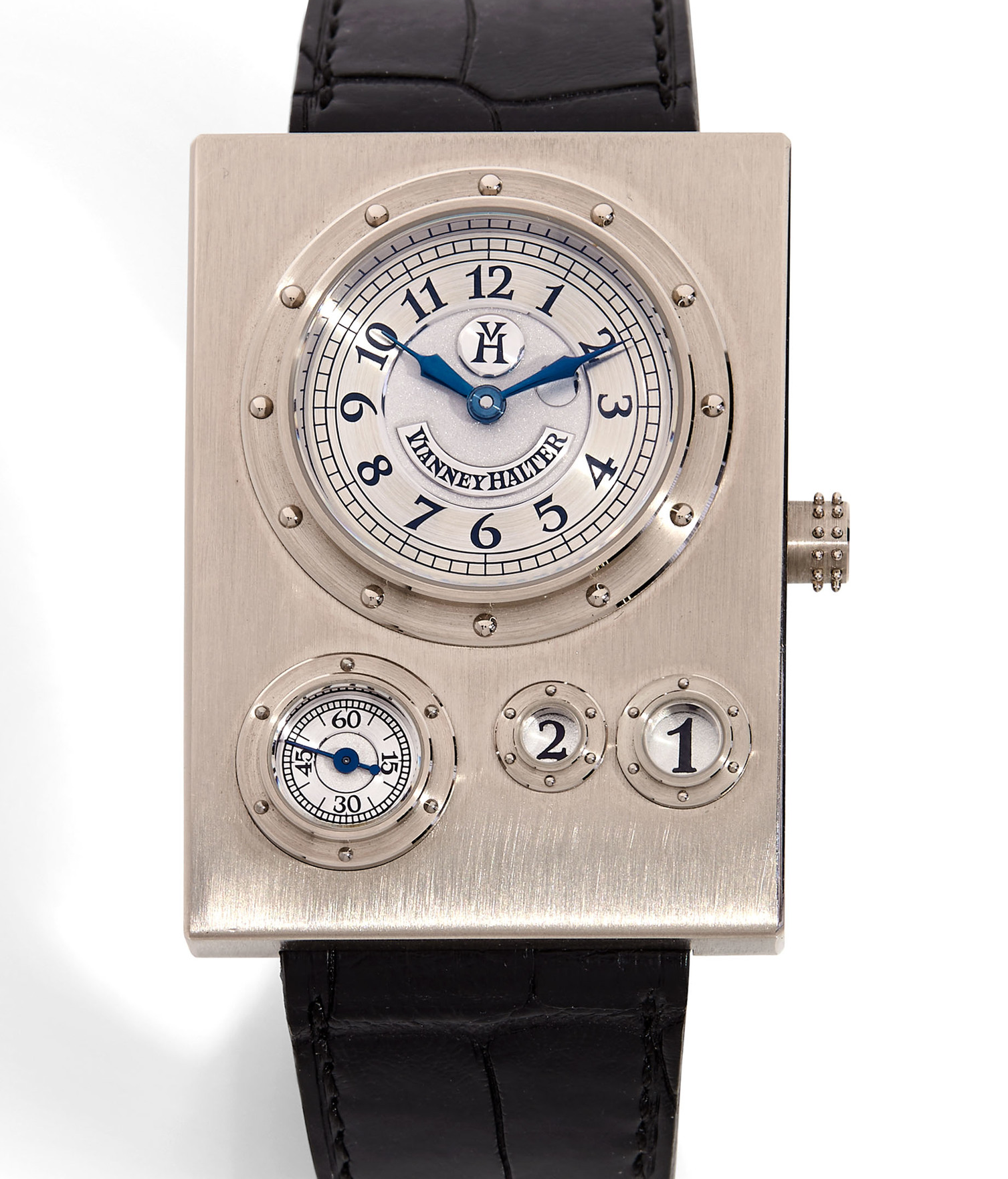
The brand's official debut came in 1998, when Halter presented the Antiqua at the Basel Fair, a perpetual calendar with a dial made up of four tiered portholes supported by cones, housed in a case studded with tiny rivets. It is a watch that imagines the future as Jules Verne's 19th century might have imagined it — Halter himself describes it as a piece that "Captain Nemo could have designed" — and it inaugurated the industrial, sculptural language, later dubbed "steampunk", with which his name would forever be associated. The Antiqua immediately impressed Philippe Dufour, who was won over by it, and in 2000 Halter joined the Académie Horlogère des Créateurs Indépendants (AHCI), the association founded in 1985 by Svend Andersen and Vincent Calabrese to bring together and support independent watchmakers: since then Halter has become one of its most identified and cited figures, so much so that he is often remembered, together with a few other names such as Journe and Dufour themselves, among the protagonists who made the AHCI the reference point of so-called contemporary "independent watchmaking".
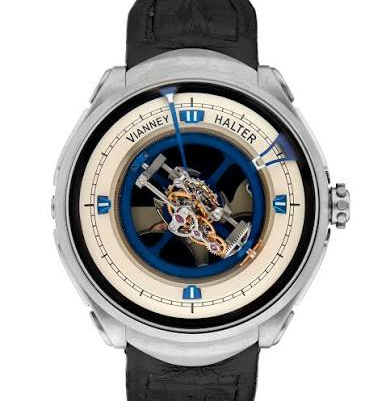
In the following twenty-five years the Manufacture Janvier's output remained deliberately artisanal and tiny: just over a dozen models in total and fewer than 500 pieces signed Vianney Halter leaving the workshop, one of the smallest and most sought-after catalogues in all of haute horlogerie. In 2013 Halter presented the Deep Space Tourbillon, a triple-axis tourbillon under a sapphire dome that marked the shift from the Antiqua's 19th-century aesthetic to a more openly science-fiction imagery, indebted as much to Jules Verne as to film and television science fiction. In recent years his name has also reached beyond independent watchmaking through collaborations with other brands — in particular with Louis Erard, for which since 2020 he has signed several editions of the "Le Régulateur", designed to make the language of a watchmaker otherwise reserved for very few collectors accessible to a wider audience.
Halter's career has been recognised with several awards, including the prestigious Gaïa Prize in 2016, and with participation in several editions of the Grand Prix d'Horlogerie de Genève. Today he is unanimously considered, together with a handful of other founding names of the AHCI, one of the fathers of contemporary independent watchmaking: a craftsman able to combine the manual skills of an antique watch restorer with a radical aesthetic vision recognisable at a single glance.